The Agent Patch
Overview
In this software, multiple AI agents listen to a piece of music, analyze its structure and progression, and reconstruct and remix it. The agents operate the parameters of a modular synth plugin, or the CV parameters of an actual physical modular synthesizer.
The current prototype is a headless application: given a 2-track source, stems, or an Ableton Live .als file, it analyzes the material, holds discussions, generates effect patterns, and renders audio — all through offline rendering.
Beyond the audio itself, the system also generates visualizations of the agents' conversations, the modular synth patching and effects, and — as a further derivative — VJ visuals.
Three Projections
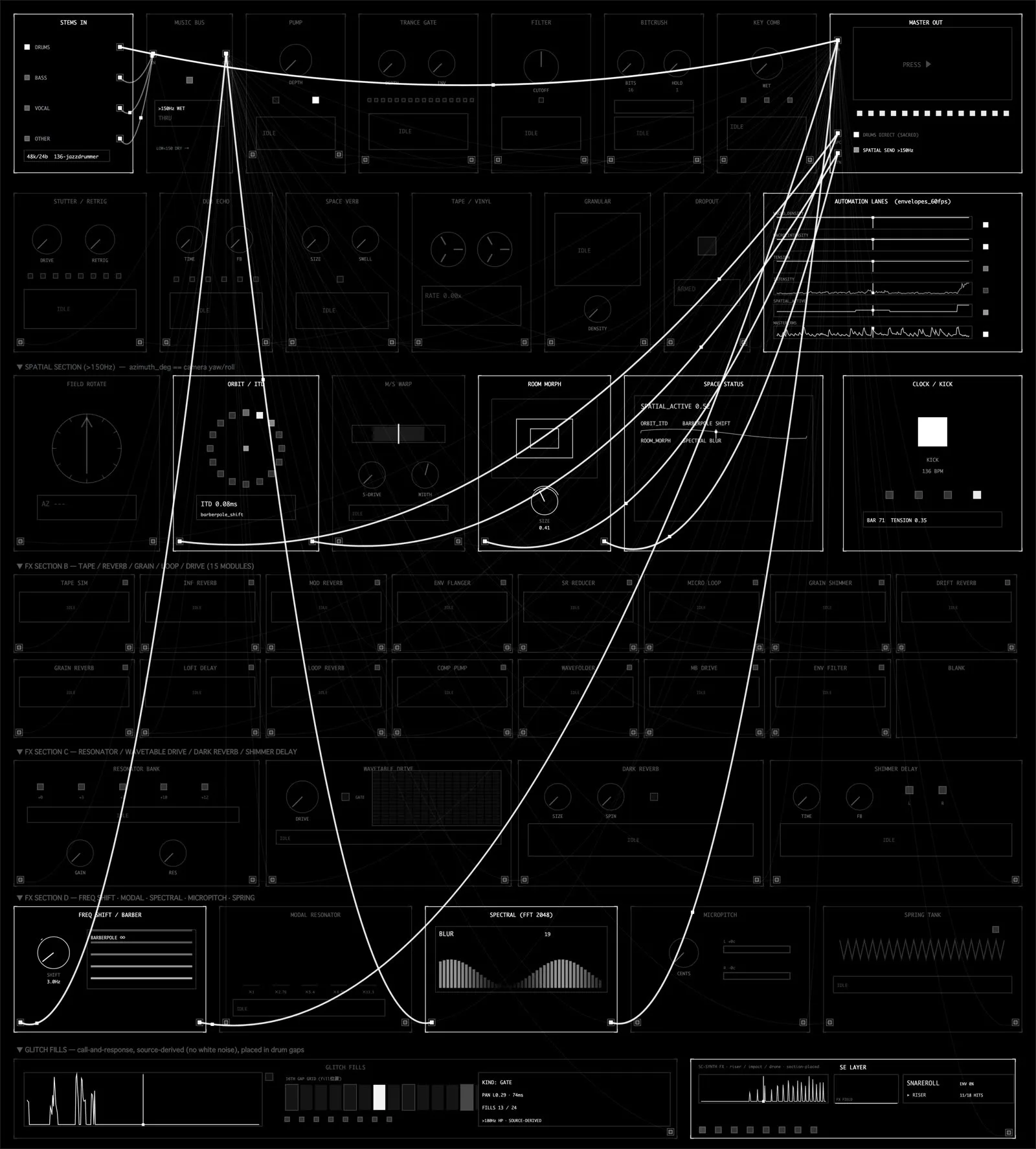
Every output is generated from a single source of truth: measured 60fps event data (JSON). Audio, the modular visualization, the agents' discussion, and the VJ visuals stay synchronized with frame accuracy.
Modular Rack
The actual signal flow of the effects applied by the agents, visualized as a virtual modular rack. Patch cables, knobs, LEDs and automation lanes are driven by measured values.
Agent Conversation
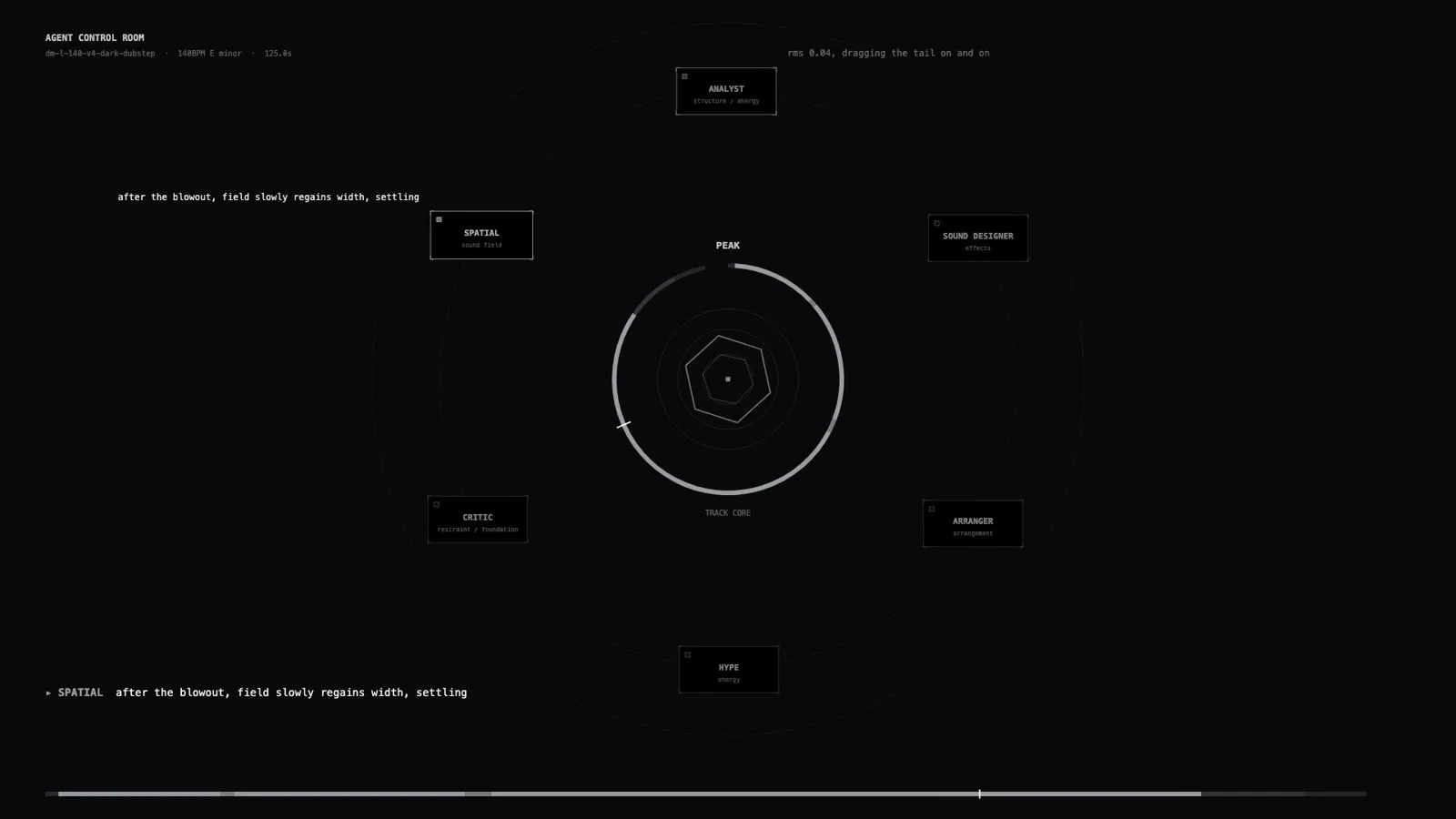
Six roles — ANALYST / SOUND DESIGNER / ARRANGER / HYPE / CRITIC / SPATIAL — discuss the track as they listen, visualized as a node graph.
VJ Visual
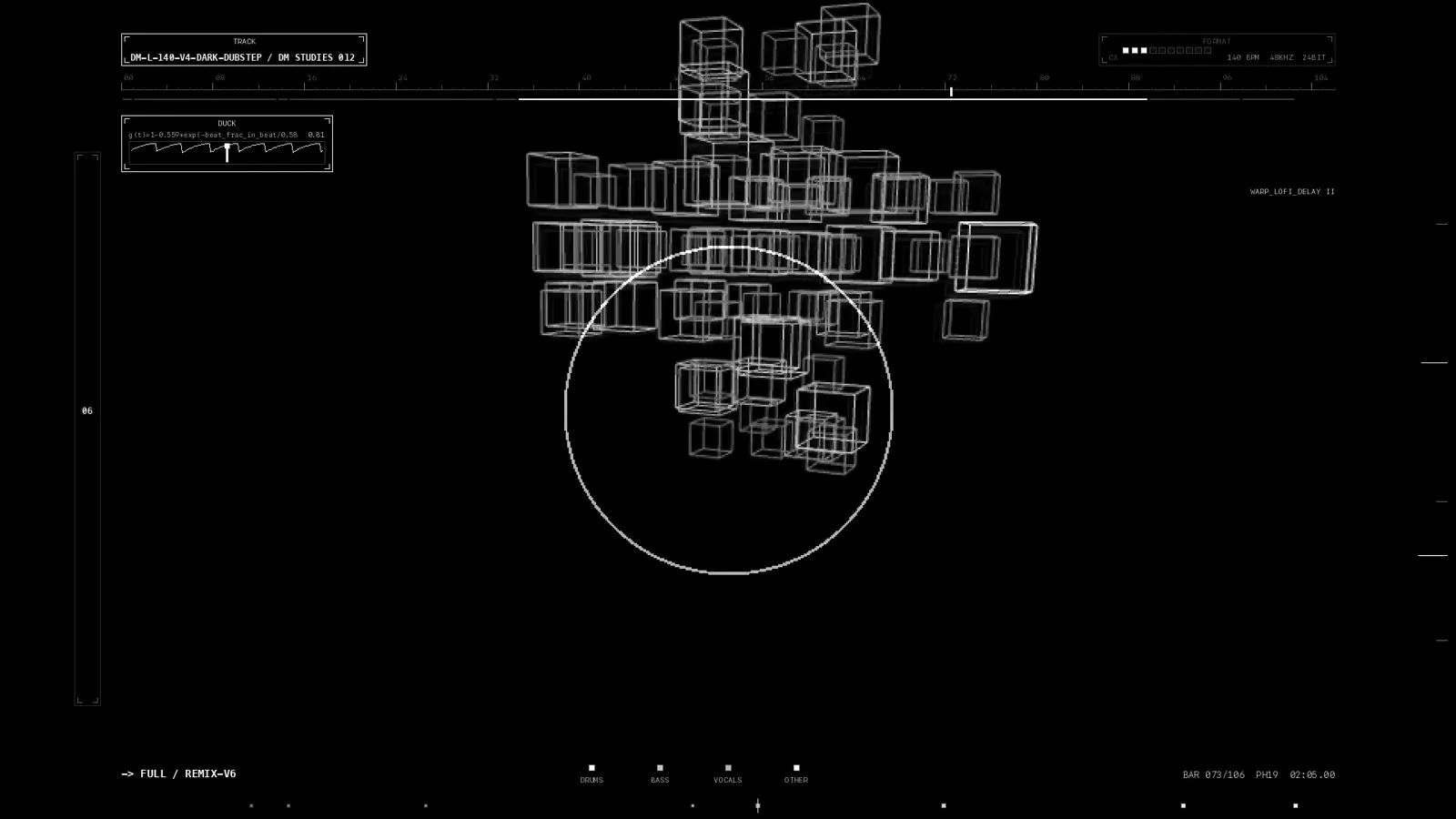
VJ visuals derived from the analysis data and events, rendered offline in perfect sync with the remix's progression and effect triggers.
Technical Details
The pipeline is fully deterministic: the same input always reproduces the same audio and visuals. Stem separation (Demucs), musical analysis, multi-agent LLM discussion generation, gesture remixing through 62 DSP processors, spatial processing, a SuperCollider-synthesized SE layer, and the rendering of every projection all run in a single shot.
The spatial layer also supports multichannel output. The measured azimuth and width curves recorded in the event JSON are re-projected onto arbitrary speaker rings (quad / 5.0 / hexa / octa / custom) via VBAP, while everything below 150Hz is always distributed equally to all speakers to anchor the rhythmic foundation. The same curves double as synchronization channels for camera motion and lighting.

What's Next
We will extend the system toward real-time performance and interactive production workflows, including live operation in which the agents control a physical modular synthesizer via CV.
We are also exploring the development of multiple hardware modular synthesizers, and we welcome collaborations with anyone — individuals or companies — interested in this direction.
Related reference pages
Open the FAQ, glossary, authority, measurement, and AI index pages. Each link now states what it is for.