TOKYO 2020-2021
Photo: Muryo Homma (Rhizomatiks)
Abstract
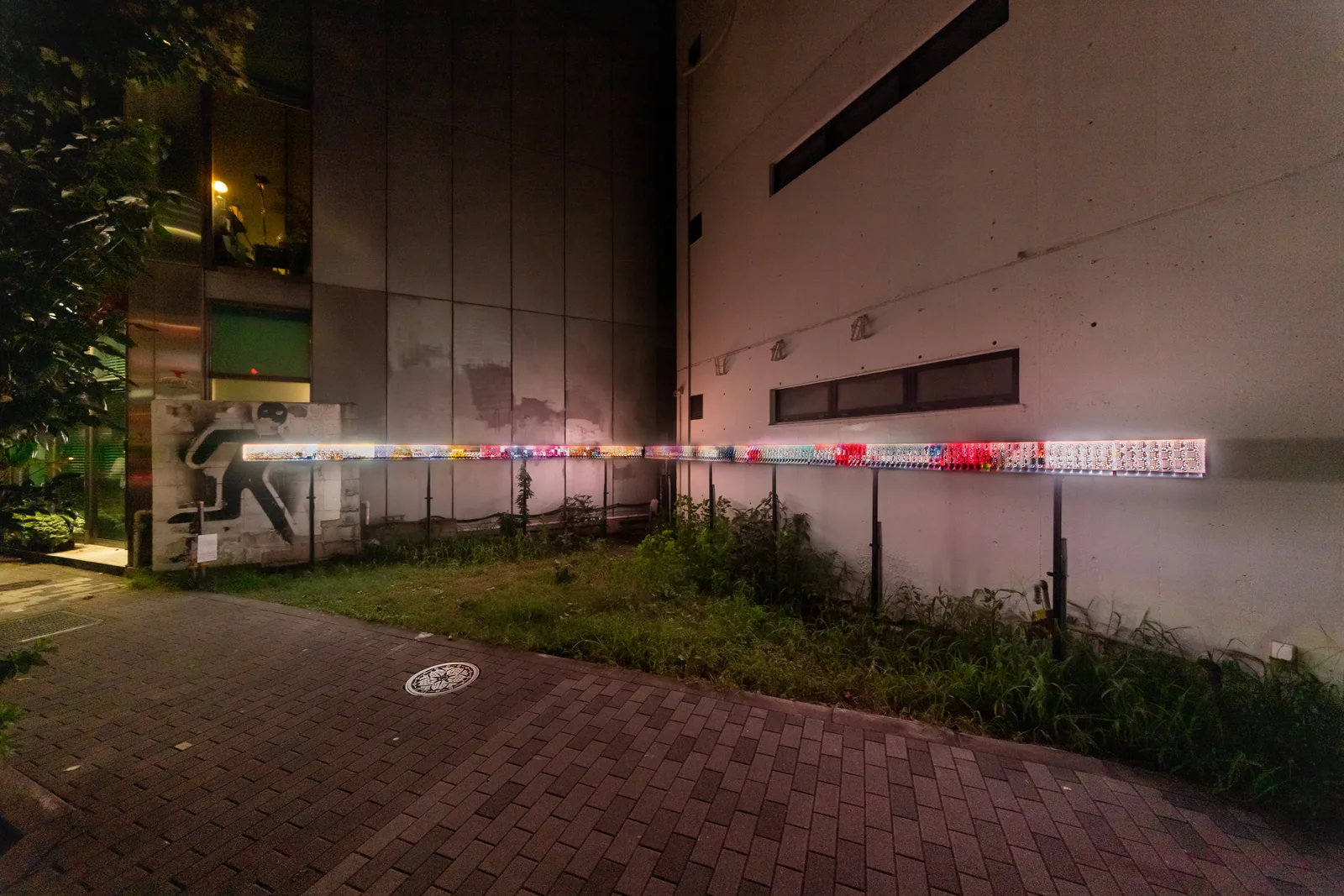
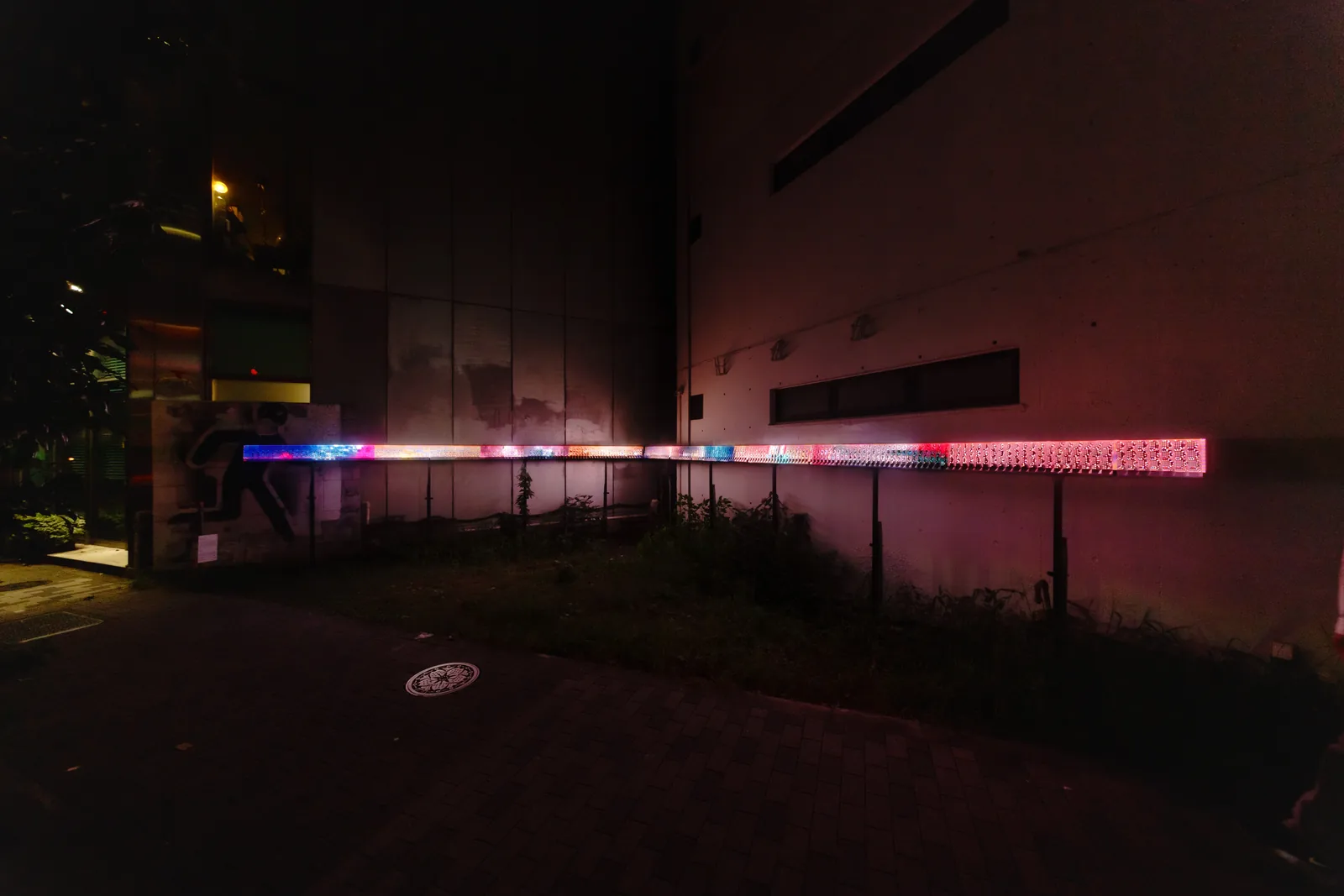
Using a wide range of data collected between the first COVID-19 state of emergency declared in the spring of 2020 and the summer of 2021, this work presents an image of Tokyo in a state of ecstatic frenzy as generated by artificial intelligence. Data that had originally been intended for other purposes, as well as information related to events that were cancelled or disappeared due to the pandemic, were abstracted and transformed into textual and visual expressions.
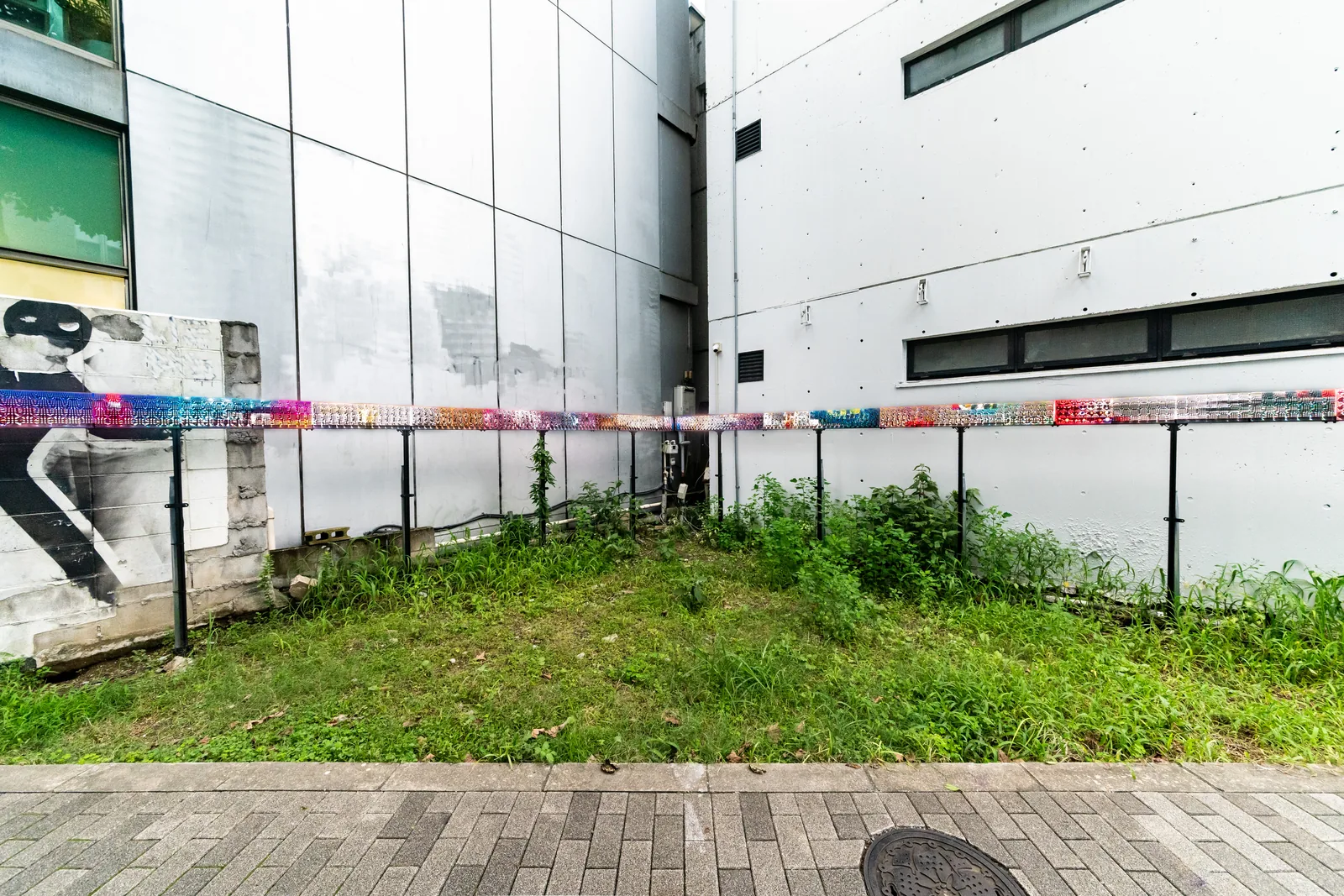
The work was produced as part of Pavilion Tokyo 2021, a world-first initiative that proposed a new and open urban landscape by installing buildings and objects across multiple locations centered around the New National Stadium. The installation was exhibited on an empty lot in front of the Watarium Art Museum.
Concept
This project originated from a commission by the Watarium Art Museum to conceive an installation in the vicinity of the New National Stadium during the period of the Tokyo Olympic Games. While the overall project was primarily driven by architects, I was asked to develop an approach distinct from architectural or spatial design. Given the social conditions of the time, this division of roles itself constituted an unusual and historically specific framework.
Between 2020 and 2021, preparations for the Tokyo Olympics unfolded simultaneously with the global spread of COVID-19, creating unprecedented social circumstances. Many cultural projects were cancelled or postponed, while at the same time the pandemic itself became a condition that enabled new forms of experimentation. The weekly online live-streaming series Stayin Tokyo was one such attempt, exploring networked simultaneity and connection under conditions where physical movement and gathering were severely restricted.
This period also marked a critical moment in which the production, circulation, and credibility of information were widely questioned. Distrust toward mass media intensified, and individuals faced profound uncertainty regarding how to interpret and act upon information related to the Olympics, infection statistics, and vaccination. Determining what to believe became increasingly difficult.
In response, this work focuses on anonymous expressions of sentiment—voices that tend to remain invisible in public discourse. As a material reflecting the discursive environment specific to this period, comments posted on Yahoo! News were selected as the primary dataset. In particular, comments associated with Olympic-related articles were collected and used to fine-tune a Japanese-language implementation of GPT-2 (commonly referred to as the "Rinna version"). Texts generated by this language model were then presented in the installation, aiming to visualize the structure of collective emotion and linguistic distortion.
In addition, image generation experiments were conducted using the generated texts as input, employing the generative technologies available at the time. Video generation, in particular, was still at an early stage of development; compared to current generative AI, resolution and coherence were severely limited. Rather than treating these limitations as flaws, the work deliberately embraced their instability and breakdown as expressive qualities. All generative processes were fully automated through scripting, minimizing human intervention and aesthetic judgment in order to position the work as a neutral generative system.
At that time, generative models lacked the filtering and safety mechanisms that are now common, frequently producing discriminatory, aggressive, or otherwise hazardous text. Consequently, the exhibition design itself functioned as a form of control. Physical mosaic lenses were employed so that passersby could not readily read the text, while viewers who intentionally approached the work were able to decipher its content.
Produced at the intersection of technological constraints, social tension, and ethical uncertainty, the creation of this work can be understood as a puzzle-like process—assembling and balancing elements that collectively embodied the conditions of the era.
I am deeply grateful for the opportunity to present a work that would have been difficult to exhibit within a conventional museum context. At the same time, this project reaffirms the historical and critical significance that can emerge precisely because a work is created under such exceptional temporal and social conditions.
Tokyo Tokyo FESTIVAL Special 13
PAVILLION TOKYO 2021
Organizers: Tokyo Metropolitan Government, Arts Council Tokyo (Tokyo Metropolitan Foundation for History and Culture), and Executive Committee of Pavilion Tokyo 2021
Planning: WATARI-UM, The Watari Museum of Contemporary Art
1st JUL. -5th SEP. 2021
Venue: Open space in front of WATARI-UM
3-41-5, Jingumae, Shibuya-ku, Tokyo
Opening Hours: 11:00-19:00
Technical Direction: Motoi Ishibashi
LED Player: Yuta Asai
Image and Text generation: 2bit
Technical Support: Toshitaka Mochizuki
Project Management: Tomoyo Obata
Photo: Muryo Homma (Rhizomatiks)