VS. SOUND NIGHT
VS. SOUND NIGHT
Produced by Circus Osaka
9/22[SUN] & 9/28[SAT] START/OPEN 19:00 - CLOSE 23:00 ¥1,000
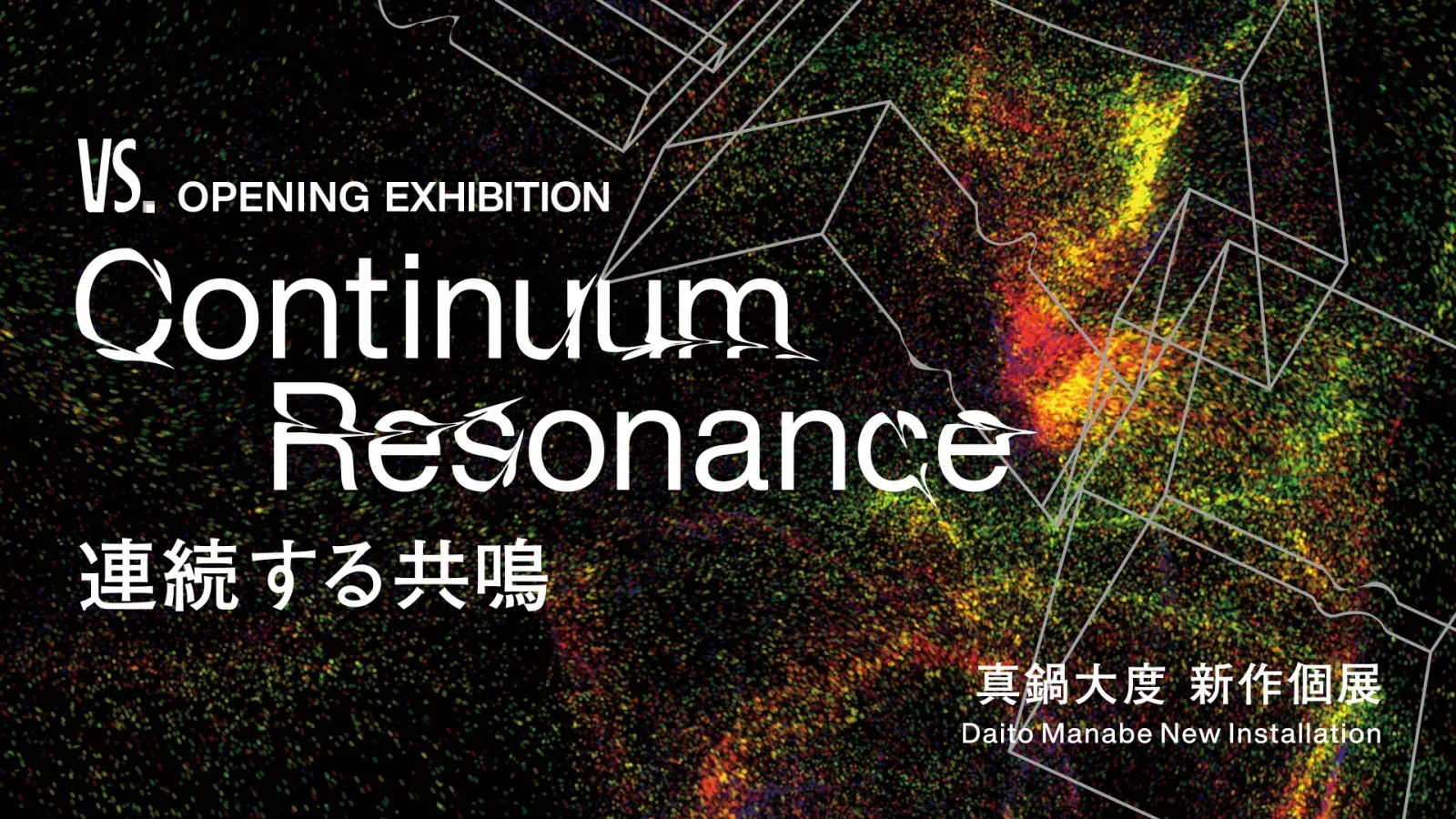
This exhibition consists of works created using mathematical algorithms, music programming, and 3D architectural data. These works are installed in various spaces of "VS."
Daito Manabe places great importance on exploring the relationship between mathematics and music as the foundation of his artistic activities. One of his influences is the Greek contemporary composer Iannis Xenakis's "Music and Architecture" (1971). At "Expo 58," Xenakis, in collaboration with architect Le Corbusier, created an experimental and innovative work that filled the entire space with organic light, color, video, rhythm, and electronic acoustics. This was a pioneering expression that could be considered the origin of media art.
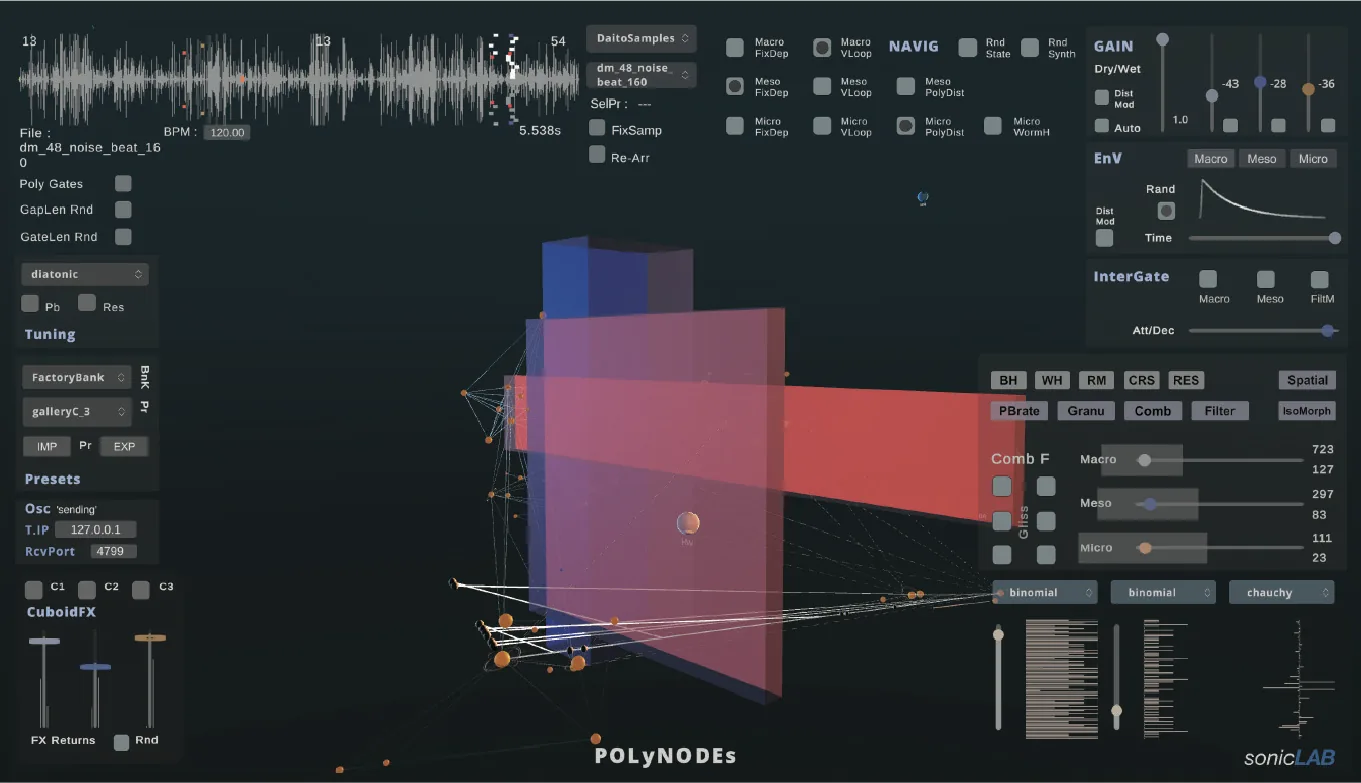
In this exhibition, Manabe extensively uses the groundbreaking 3D audio software "PolyNodes" (2024), which he co-developed with Sinan Bokesoy (artist/composer). This software allows for extensive design and visualization of sound movement and changes within a 3D space. By dynamically controlling the position, intensity, and tonal changes of sound within the space, and simultaneously applying these adjustments to the visual elements accordingly, it creates an immersive experience where sound and visuals are fused. This enables viewers to experience an unprecedented audiovisual space.
"PolyNodes" is an innovative generative audio synthesis tool* that revolutionizes music production and 3D sound design. It was jointly developed and introduced in 2024 by Sinan Bökesoy (artist/composer) and Daito Manabe.
This system was developed with an approach that sets it apart from conventional DAWs (Digital Audio Workstations), featuring a groundbreaking mechanism that visualizes sound in 3D space and enables intuitive operation. While it allows for the creation of new sounds without the need for music theory or advanced programming skills, it also provides a production environment for experts with deep knowledge of acoustics to visually express their insights and explore new possibilities in sound design.
The software automates the generation and modulation of sound through algorithms and rules, creating soundscapes and acoustic structures that unfold along a time axis through design modeling, without direct human input. In addition to linear geometric concepts, it incorporates parameters such as Black Hole and White Hole to accommodate non-linear changes. Generative sound synthesis is not defined solely by model complexity, algorithmic manipulation, or the latest AI techniques. Rather, it is characterized by its ability to intuitively reflect the designer's thinking as software that accurately grasps and embodies acoustic design elements such as timbre evolution, acoustic interactions, and structural nuances of sound.
Music tools that automatically generate and modify sounds using computer algorithms. The design of the algorithm itself becomes the composition process, expressing the evolution and interaction of sounds. These tools embody the designer's vision through various technologies, pioneering new frontiers in music production. They represent an advanced creative approach that fuses technology and art.
This exhibition explores the technical and expressive possibilities of "PolyNodes" through four exhibition spaces of different shapes, presenting new relationships between acoustic technology and three-dimensional spatial expression from both real-time generation and pre-design perspectives.
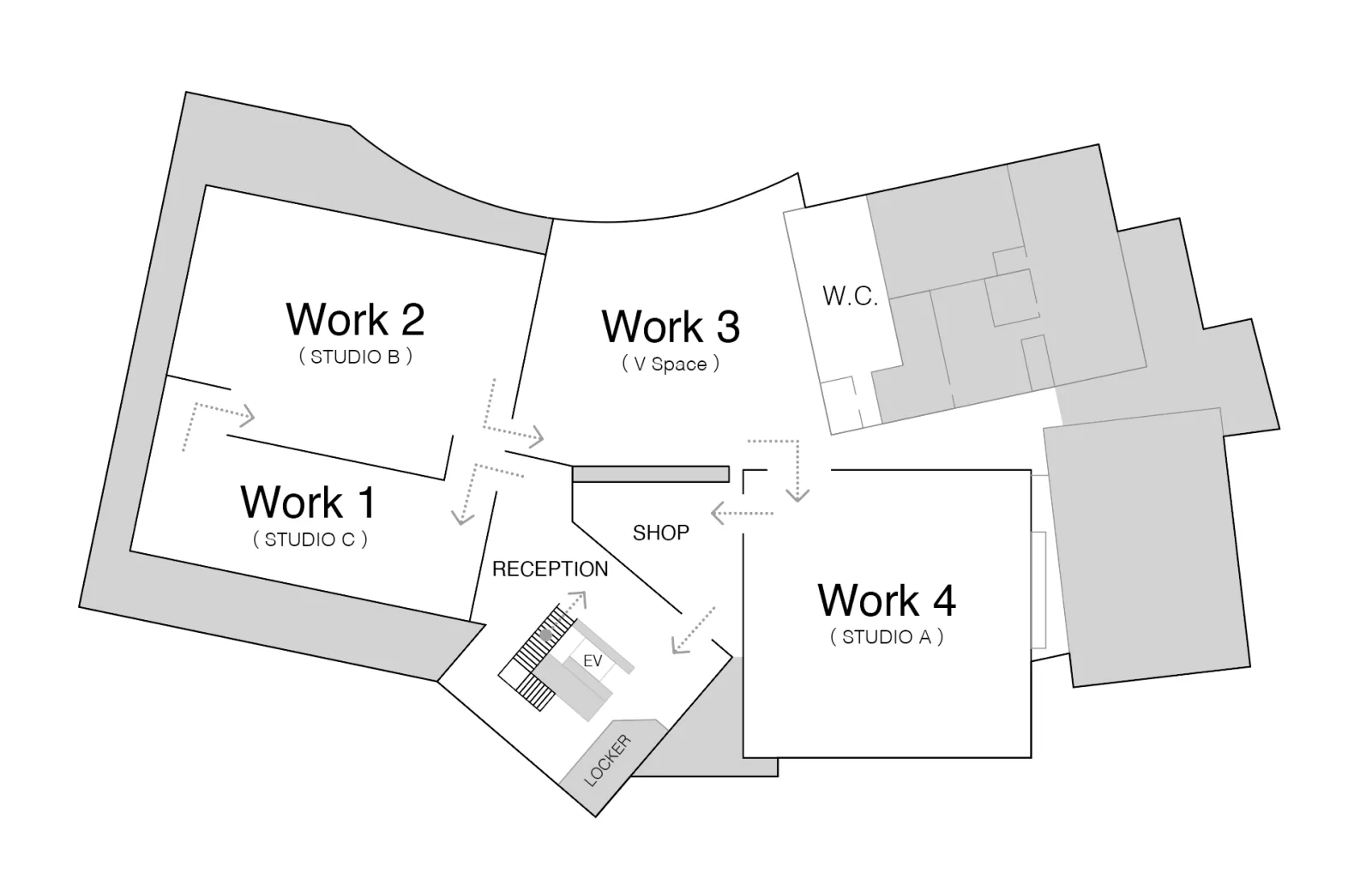
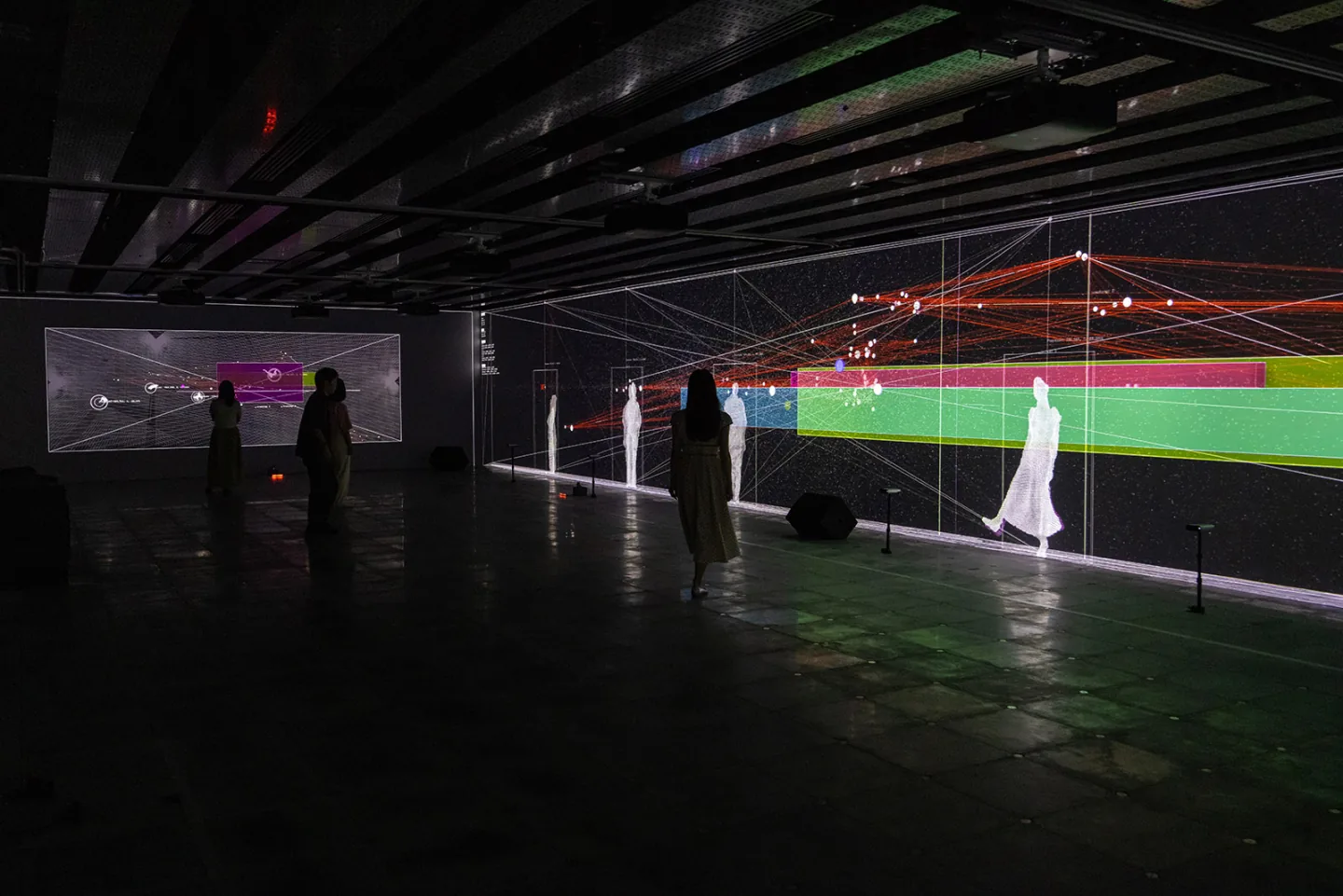
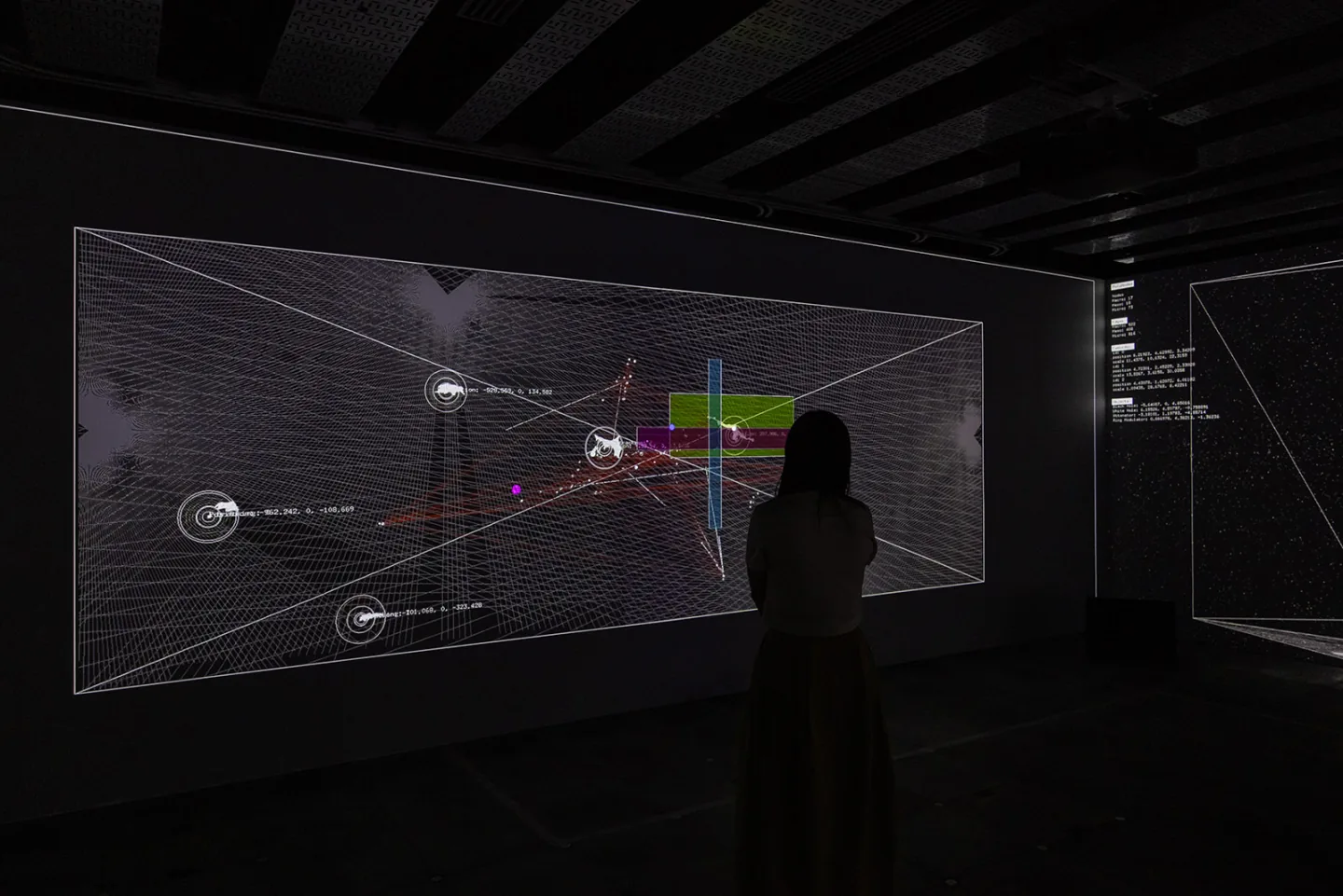
In this space, the visitor's position data and the spatial characteristics data of the exhibition area are analyzed, and through complex parameter control, real-time sound generation and output are performed. The projected visuals display the sensor information and the operation of "PolyNodes". This creates a space where one can concretely understand the effects and functions of "PolyNodes".
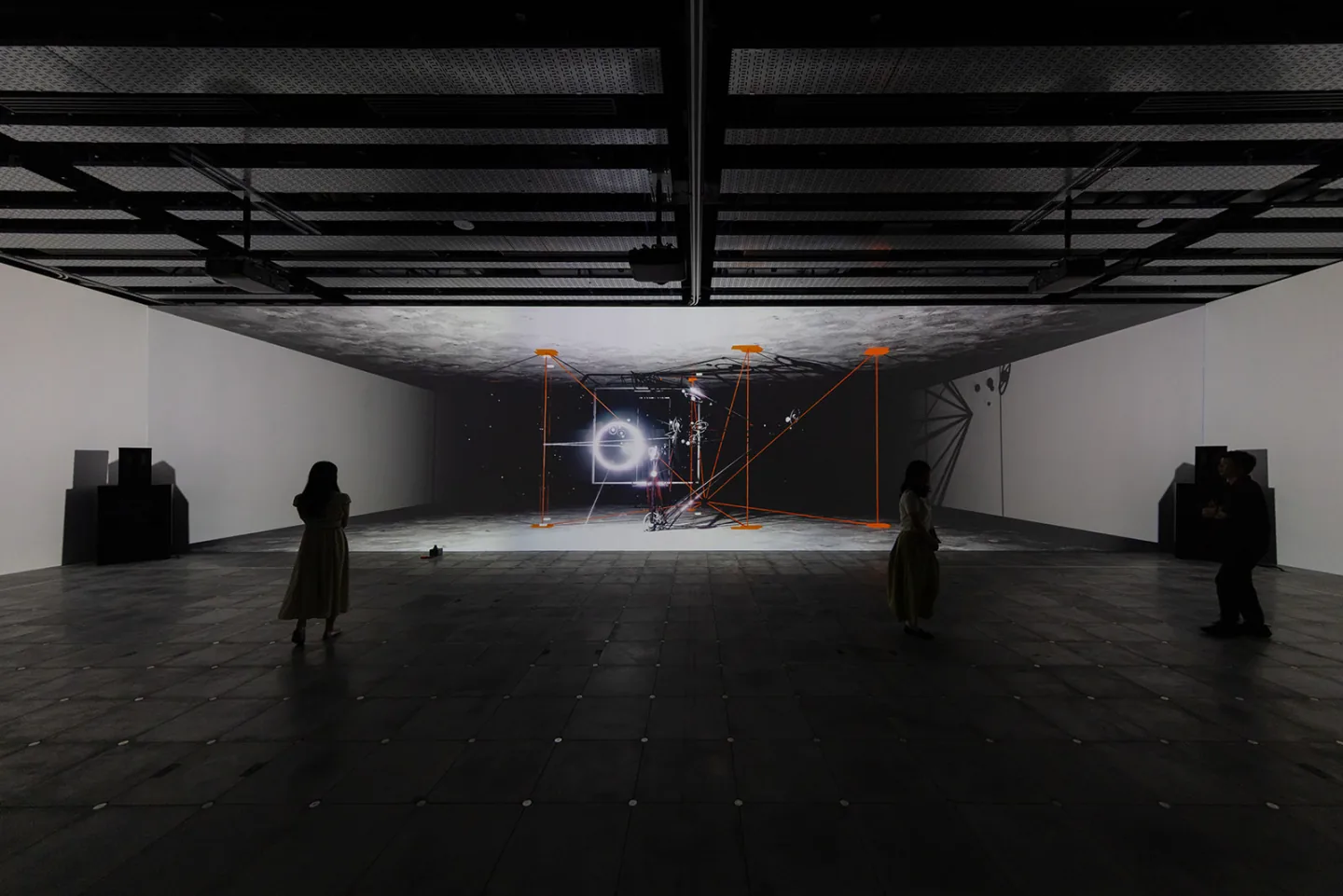
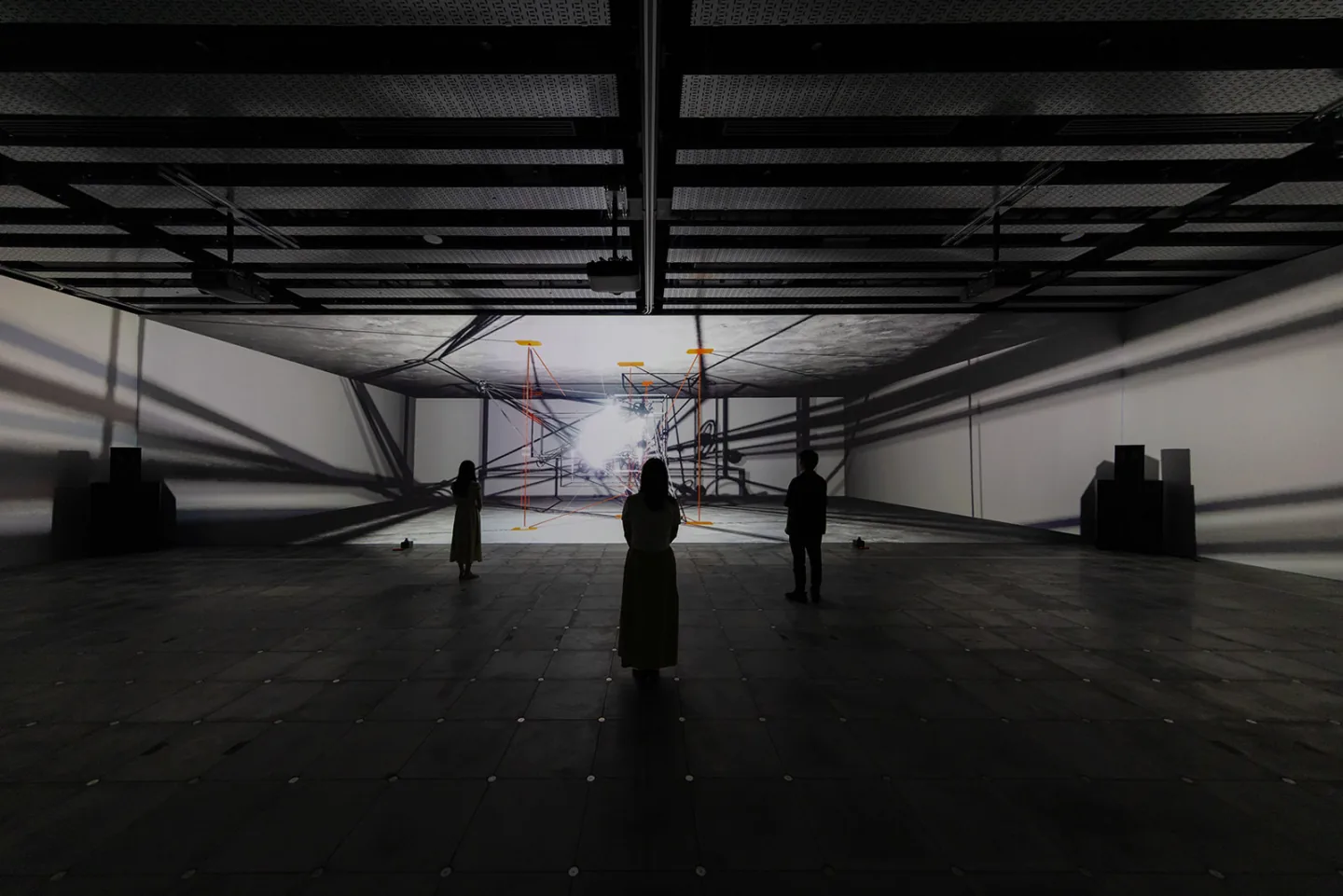
This work analyzes visitor position data and spatial characteristics data of the exhibition venue to generate real-time acoustics through complex parameter control of "PolyNodes" (especially using the "Black Hole"* parameter). Additionally, synthesizer and drum sounds are added to produce the final acoustic output. The projection visuals are generated in real-time using "PolyNodes", the generated sound, and sensor data.
*Black Hole: A parameter within "PolyNodes" that activates non-linear spatial effects.
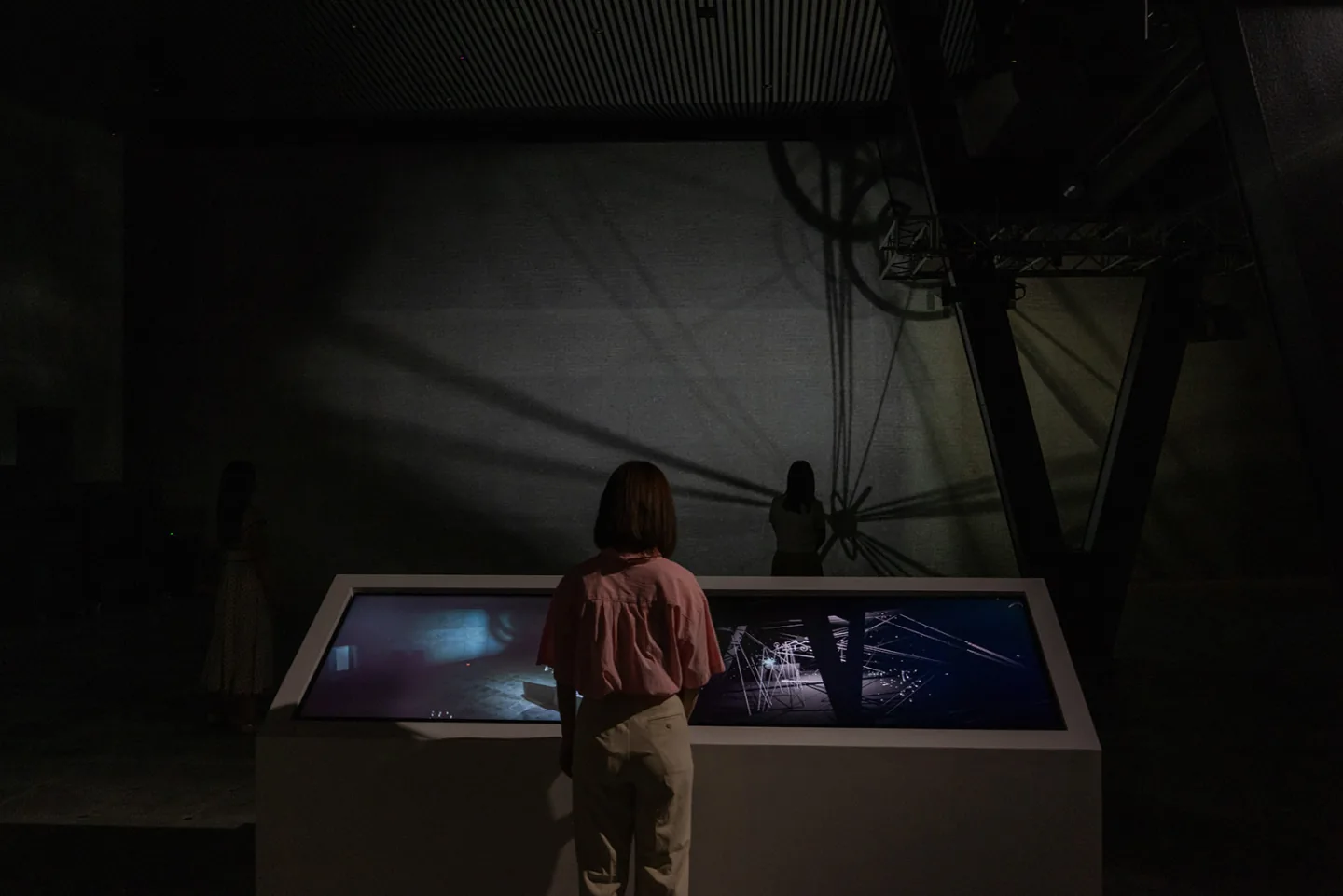
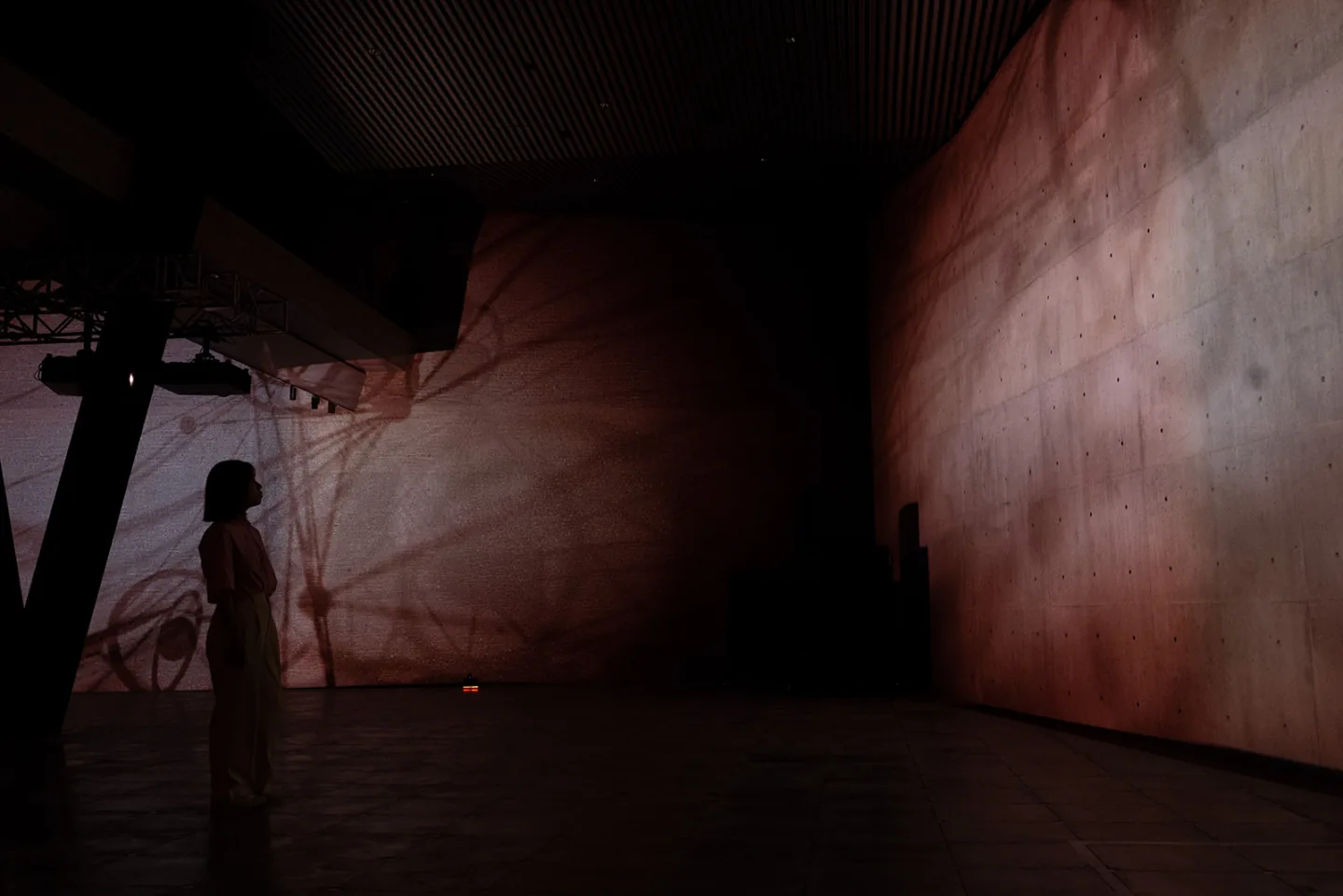
This work generates sound using "PolyNodes" by analyzing dynamic data (visitor movement, camera footage, etc.) and static data (architectural space characteristics). Furthermore, the shadows of the three-dimensional objects operating inside "PolyNodes" are projected onto the walls, visualizing and expanding them into audiovisual expressions. Additionally, here it is also possible to experience AR (Augmented Reality) technology through a special display.
![作品 Synthesis of Body-Space-Music [身体・空間・音楽の融合]その1](../assets/en/work-4-1-1440.webp)
![作品 Synthesis of Body-Space-Music [身体・空間・音楽の融合]その2](../assets/en/work-4-2-1440.webp)
This space utilizes a specially shaped area with an exceptionally high ceiling, using spatial measurement data, dancers' physical movement data, and pre-created "PolyNodes" sound sources as materials. With the themes of body, space, and music, it develops a unique expression that is only possible in this particular space. Visitors can experience an immersive audiovisual environment that makes full use of multi-projection techniques.
For this exhibition, I initially contemplated a comprehensive display of works spanning the past two decades, aiming to reexamine the trajectory of my individual artistic endeavors. However, inspired by Tadao Ando's architecture, I pivoted towards a novel challenge.
The foundation of my creative process is rooted in mathematics and music. During my university years, I was profoundly influenced by Iannis Xenakis's seminal book "Music and Architecture," which catalyzed the germination of my current artistic pursuits. Since that formative experience, I have diligently studied various methodologies, accumulated diverse experiences, and explored multifaceted forms of expression.
For this exhibition, "Continuum Resonance," I have chosen to fully leverage the potential and spatial characteristics of this building to create a new work that reinterprets the origins of my creative process within a contemporary context. Through a dialogue with Ando's architectural space, VS., I aspire to produce an innovative piece that synthesizes my cumulative experiences with cutting-edge technological advancements.
In this exhibition, unique audiovisual installations are featured in each space of VS. (Works 1-4). The audio and visual elements of each space are created based on the 3D audio design software "PolyNodes"*. Through this system, we provide an integrated experience of architectural space data, viewer movement data, and generated sound.
One of the inspirations for "PolyNodes" comes from the thoughts and methods of Iannis Xenakis (1922-2001). "PolyNodes" was developed by greatly expanding Xenakis's ideas from a contemporary perspective while integrating various concepts. A pioneering example of media art by Xenakis is the Philips Pavilion at the 1958 Brussels World's Fair (Expo 58). Xenakis, who was in charge of architecture, space, and acoustics, created a unique geometric architectural form that fused organic internal organ shapes with mathematical hyperbolic paraboloids. Furthermore, by dispersing 425 speakers on the interior walls, he created a unique acoustic space. Later, Xenakis developed the idea of spatial acoustic particles and created the "Polytope" series of electronic acoustic-optical installations (1960s-80s). Also, for the "Steel Pavilion" at the 1970 Osaka Expo (Expo '70), he composed the tape music "Hibiki-Hana-Ma" for a ring-shaped music hall with 1,008 speakers distributed throughout the space.
"PolyNodes" extends traditional 2D waveform representation into 3D space, enabling the exploration of continuously changing spaces. This software has been released as a plugin available to everyone, providing the latest technology for 3D acoustic space generation. This work, "Continuum Resonance," utilizes the "PolyNodes" system to explore various possibilities, challenging to fuse architecture, music, and technology in new ways.
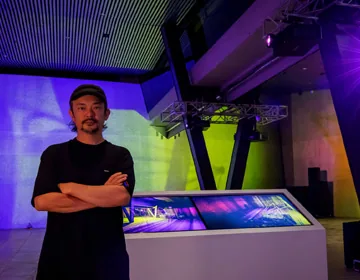
On September 6, 2024, a completely new cultural installation, “VS.”, was born. The opening exhibition is “Continuum Resonance” by Manabe Daito. Who is Manabe Daito?Moreover, what is he aiming for through VS.? We interviewed him on the opening day.
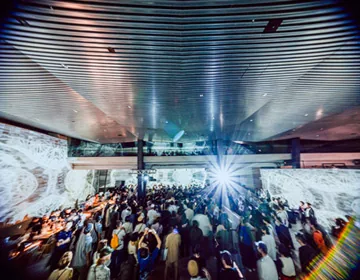
The performers include the exhibition artist Daito Manabe, as well as Osaka-based DJs and VJs as guests. Using the powerful bass produced by VS.'s unique ultra-high sound system and the video system of the exhibited works. Please join us, a dynamic audiovisual experience !!
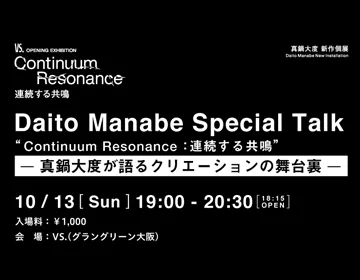
A special lecture by artist Daito Manabe will be held at VS. In this lecture, Daito Manabe will give a presentation of his new installation “Continuum Resonance” including the background and production process of the work, and also the mechanism of the generative audio synthesis tool “Polynodes” used in the work.
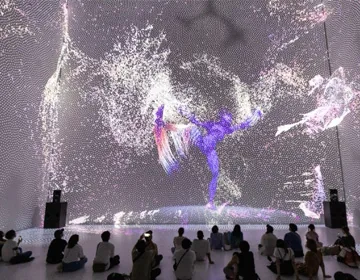
"Continuum Resonance" was planned as a solo exhibition by Japanese artist, Daito Manabe. The groundbreaking nature of this project could be said to have made an epoch-making leap in media art history, but its conception and results can also be said to owe much to the studio space composition of VS. Let me introduce a part of it.

Established Rhizomatiks in 2006. Founded Studio Daito Manabe in 2022.
Creates works by reexamining and combining familiar phenomena and materials from different perspectives. Rather than aiming for rich expressions such as high resolution and high realism, he focuses on the intrinsic fascination found in phenomena, the human body, programming, and computers themselves, which can be discovered through careful observation. His work explores the relationships and boundaries between humans and machines, analog and digital, and real and virtual. He is active in various fields, emphasizing these aspects in his creations.
https://daito.ws
Direction・Music Composition・Sound Design & Programming・Visualization Daito Manabe(Rhizomatiks, Studio Daito Manabe)
Sound Programming Sinan Bökesoy(sonicLAB)
Co-composition Hopebox
Software Engineering・Visualization Yuta Okuyama
Visualization Ayumu Nagamatsu
Software Engineering 2bit
Production Support Keke(Studio Daito Manabe)
Production Management Kosaku Namikawa
Direction・Music Composition・Sound Design & Programming・Visualization Daito Manabe(Rhizomatiks, Studio Daito Manabe)
Sound Programming Sinan Bökesoy(sonicLAB)
Co-composition Hopebox
Software Engineering・Visualization Yuta Okuyama
Visualization Ayumu Nagamatsu
Software Engineering 2bit
Production Support Keke(Studio Daito Manabe)
Production Management Kosaku Namikawa
Direction・Music Composition・Sound Design & Programming・Visualization Daito Manabe(Rhizomatiks, Studio Daito Manabe)
Sound Programming Sinan Bökesoy(sonicLAB)
Co-composition Hopebox
Visualization Ayumu Nagamatsu
Software Engineering 2bit
UE4 Engineering Tatsuya Ishii(Rhizomatiks), Futa Kera(Rhizomatiks)
Console Furniture Design Takahito Hosono(OFF-FLAT)
Production Support Keke(Studio Daito Manabe)
Production Management Kosaku Namikawa
Direction・Music Composition・Sound Design & Programming・Visualization Daito Manabe(Rhizomatiks, Studio Daito Manabe)
Sound Programming Sinan Bökesoy(sonicLAB)
Co-composition Hopebox
Visualization Satoshi Horii(Rhizomatiks)
Motion Capture Dancer Shingo Okamoto
Motion Capture Engineering Yoshitaka Homma(Crescent), Takaya Fukushima(Crescent), Kei Minoura(Crescent)
Motion Capture Session Management Takao Inoue(Rhizomatiks)
Production Support Keke(Studio Daito Manabe)
Production Management Kosaku Namikawa
Curatorial Advisor Kazunao Abe(Tokyo Polytechnic University)
Space Planning Advisor Kenichi Togawa(burr), Masaki Takei(burr)
Space Design Takahito Hosono(OFF-FLAT)
Architectural 3D Scan Tadayuki Suzuki(Crescent), Kazumasa Yasuda(Crescent)
Modeling Masahiro Kadokawa(Cuddys Pic), Yasuhumi Matsuura(Cuddys Pic)
Architectural 3D Scan Coordination Takao Inoue(Rhizomatiks)
PR Design Hiroyasu Kimura(Rhizomatiks), Takuma Shukuin(Rhizomatiks), Yuko Nagamatsu
Archival Filming and Shooting Muryo Homma(Rhizomatiks)
Translation Naoki Ishizuka(Rhizomatiks)
Project Management・PR Rina Watanabe(Studio Daito Manabe)
PR Support Tomoko Yotsumoto(Rhizomatiks)
Project Management・Produce Takao Inoue(Rhizomatiks)
Chief Executive Producer Takuya Nomura
General Manager Daichi Yabe
Project Producer Yukiko Tasaki
Project Manager Ritsu Fukumoto
Operation Director Shigenobu Kobayashi
Assistant Manager Ayaha Tanaka
Promotion Planning Yuuki Kashimoto(Creative Universe), Ryo Ikeshima(Playable)
Generl Production Management Junpei Haga(Totalmedia Development Institute)
Interior Construction GODO
Space Construction(Video) TAKENAKA Co., Ltd.
Space Construction(Audio) Hiroyasu Sato(Eastern Sound Factory), Shuhei Hanai(871DESIGN), Ryo Kozuki(artical)
Space Construction(Lighting) Yanase Lighting
PC Equipment Support raytec(THIRDWAVE CORP.)
Operation Sold Out
Open the FAQ, glossary, authority, measurement, and AI index pages. Each link now states what it is for.