Brain Processing Unit hero 1
KV 1
Brain Processing Unit hero 2
KV 2
Brain Processing Unit hero 3
KV 3
Brain Processing Unit hero 4
KV 4
Brain Processing Unit hero 5
KV 5
Brain Processing Unit hero 6
KV 6
SoftBank Daito Manabe The University of Tokyo Special Exhibition

Brain Processing Unit

- The Future Where Biology and Computer Integrate -
2025.02.01 Sat - 2025.02.09 Sun
A complete reconstruction of SoftBank's Brain Processing Unit special site for the Daito Manabe website, including every major section from the original English page.
Collaboration
SoftBank R&D / Daito Manabe / The University of Tokyo
Dates
2025.02.01 Sat - 2025.02.09 Sun
Scope
3 works + talk event
Package
Full text, images, programs
Overview

Overview

A full view of the SoftBank R&D, Daito Manabe, and University of Tokyo collaboration.
Collaboration
SoftBank R&D / Daito Manabe / The University of Tokyo
Dates
2025.02.01 Sat - 2025.02.09 Sun
Exhibition Venue
fil (Ebisu)
Talk Venue
SHIBUYA QWS

The rapid advancement of AI is influencing every aspect of society, from creative domains such as generating text and images to addressing significant social challenges like early disease detection and climate change prediction.

This technological innovation is profoundly transforming the way we work and live, while also challenging us to reconsider what defines the unique strengths of humans.

Today, the distinctive abilities of the human brain—such as adaptability to unfamiliar environments and remarkable learning efficiency—are garnering renewed attention and focus.

The SoftBank Research Institute of Advanced Technology has been focusing on these brain functions and actively researching their application to computing technologies.

One of our key breakthroughs involves 'cerebral organoids,' small artificial brain tissues created using iPS cells.

By constructing and controlling cultured neural circuits with these organoids, we believe it is possible to develop accelerators that leverage the strengths of the brain.

We have named this the 'Brain Processing Unit (BPU),' and since 2022, we have been collaborating with artist Daito Manabe and the Ikeuchi Laboratory at the University of Tokyo. Together, we have been working on methods to stimulate cerebral organoids, analyze their activity data, and develop the necessary APIs, networks, and other interface technologies required for these operations.

This exhibition showcases the current state of cerebral organoid research and the vision we are pursuing through cutting-edge technologies.
Message

Message

Core statements from the exhibition and background on the collaborators.

DAITO MANABE

Through experiments and creations using cerebral organoids, this is an attempt to approach the question ‘What is consciousness?’ and ‘Why do humans react to beats and music?’ by transcending the boundaries between art and science. We hope it will be an opportunity to deepen our exploration of the origins of human consciousness and sensibility.

YOSHIHO IKEUCHI

We are conducting research to create neuronal circuits by connecting organoids. We aim to understand and unlock the mysterious mechanisms of the brain through the research.

DAITO MANABE
ARTIST

DAITO MANABE

Born in Tokyo in 1976, Daito Manabe grew up immersed in music and programming under musician parents. After experiences as a DJ and jazz band member, while studying at Tokyo University of Science, he was influenced by Xenakis and began researching mathematical approaches to music generation, which became the foundation for his later creative work.

In 2006, he founded Rhizomatiks, exploring the fusion of technology and physical expression through collaborations with Perfume and ELEVENPLAY alongside director/choreographer MIKIKO, leading to innovative projects including AR direction for the Rio Olympics closing ceremony. He has collaborated with numerous artists including Ryuichi Sakamoto, Björk, Nosaj Thing, Squarepusher and Arca, with his distinctive Audio Visual performances presented at international festivals worldwide, including Sonar Barcelona. Recently, through collaboration with neuroscientists, he creates works merging life and machinery using biofeedback systems with cultured neural cells. As Director of Rhizomatiks, he spearheads the organization while creating works through his own Studio Daito Manabe. Through collaborations with diverse creators, he continues to produce innovative pieces that explore new relationships between humans and technology.

YOSHIHO IKEUCHI
Associate Professor

YOSHIHO IKEUCHI

Yoshiho Ikeuchi is an Associate Professor at the Institute of Industrial Science, The University of Tokyo. Following his research trainings at The University of Tokyo, Harvard Medical School, and Washington University in St. Louis, he has been conducting research that integrates neuroscience and tissue engineering since 2014. By creating neural cells and tissues (organoids) from human iPS cells, his laboratory aims to understand the mechanisms underlying development, functions, diseases of the brain.

Softbank Research Institute of Advanced technology

Softbank Research Institute of Advanced technology

SoftBank Research Institute of Advanced Technology was established in April 2022 as an organization tasked with researching and developing new technologies that can be implemented into society. As agents activating social change, we will move the world forward with new technologies to help create a better future for society.

Research Area

Research Area

Research explanations and exhibition photography.

We present research on computing technologies utilizing cerebral organoids. Alongside displays of experimental equipment used for cultivation, stimulation, and measurement, we offer panel explanations covering everything from the fundamentals of cerebral organoids to the latest research developments.In particular, we highlight efforts to enhance information processing capabilities through 'connectoids'—networks of multiple cerebral organoids connected via axons—as well as the development of interface technologies that modularize complex electrical stimulation control for computational purposes.

Art Area

Works

Full texts and visuals for the three featured works.

Cellular Ears

Music transcends cultural and linguistic boundaries, evoking emotional responses in people across the globe. But how is this universal power of music perceived and processed by our nervous system?

Our brain can instantly analyze the complex elements of music and recognize its features. This project investigates the fundamental mechanisms of music recognition using cerebral organoids, shedding light on the intrinsic relationship between the art form of music and the biological systems of life.

Autonomous Robot Control through Living Neural Networks

This project explores the potential for intelligent control through biological systems, rather than relying on artificial intelligence. The adaptive learning capabilities of living organisms allow them to flexibly respond to dynamic and unpredictable environments, such as real-world settings. By incorporating actual brain neural circuits as the core of a robotic control system, this project aims to establish a novel control architecture.

The biological brain is an exceptional system that continuously processes external information in real time while acting, generating appropriate subsequent behaviors. This project investigates the unique mechanisms of learning and adaptation inherent in living systems, utilizing cerebral organoids—small-scale neural cell networks.

Life and Rhythm

Why do humans involuntarily respond to music with movement? This project explores the origins of this universal human response at the most fundamental level of life—neurons.

Our bodies constantly maintain rhythm without conscious effort. The heartbeat, synchronized brain waves, and breathing rhythms—all of these life activities exhibit inherent rhythmicity. Using cerebral organoids, this project investigates the relationship between this intrinsic rhythm of life and the response to external rhythmic musical stimuli.

Program

Program

Dates, venues, opening hours, talk sessions, and contact information.
Exhibition

Exhibition Program

Exhibition Period
Saturday, February 1, 2025 – Sunday, February 9, 2025
Venue
fil (Ebisu)
※As this is a closed space, the address will be provided after you apply using the form below.
Opening Hours
10:00〜19:00
※Last admission at 18:30
Admission
Free
Advance reservations are required for entry.
Please apply using the form below.
※Please note that time slots that are already fully booked will no longer appear on the application form.
The exhibition event has ended.
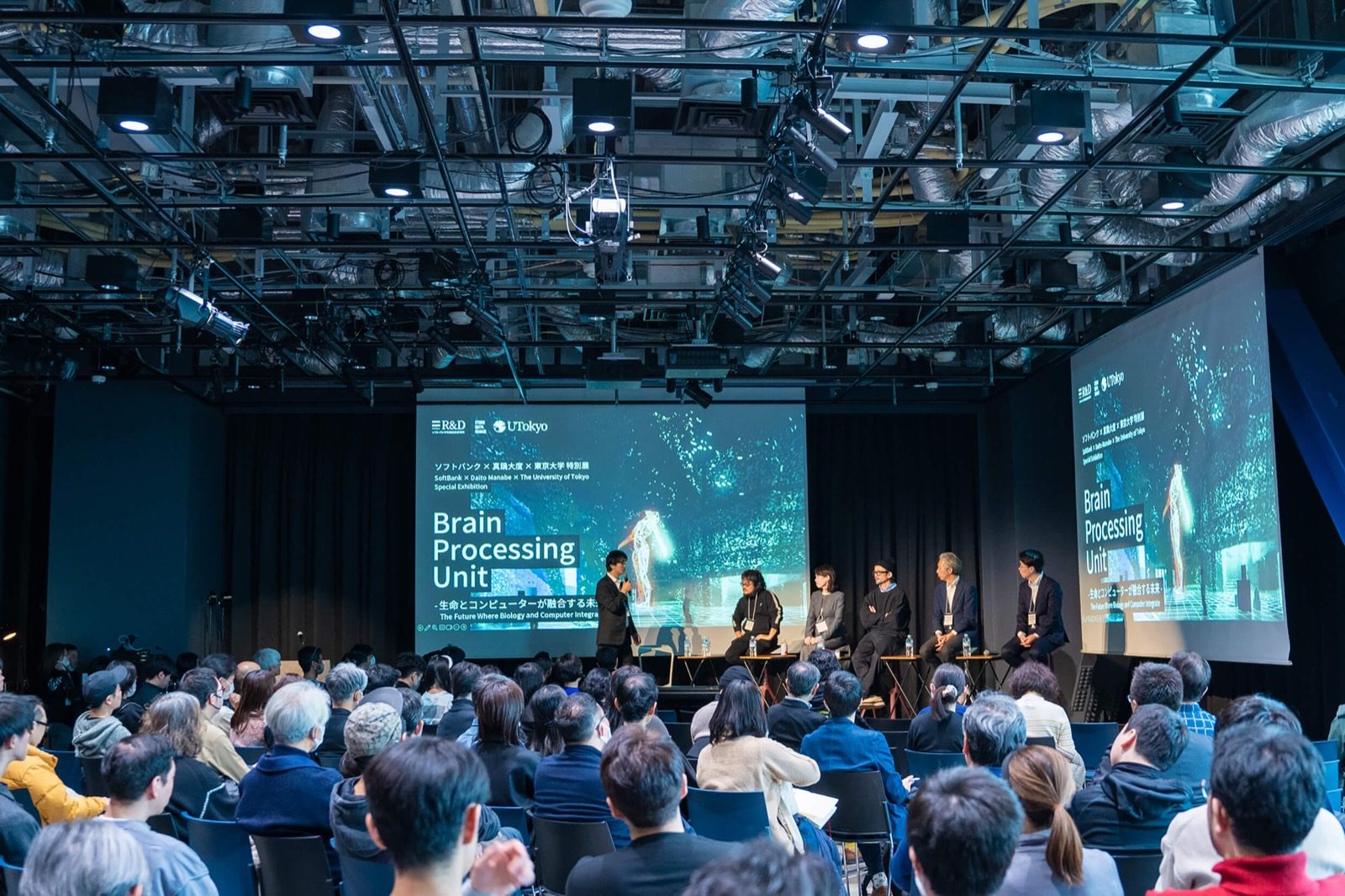
Talk Event

2025.02.01 Sat 14:00 - 16:00
@SHIBUYA QWS

Date & Time
February 1, 2025 (Saturday) 14:00 - 16:00
Venue
SHIBUYA QWS (15th Floor, Shibuya Scramble Square East Building)
2-24-12 Shibuya, Shibuya-ku, Tokyo
Please check the access directions on the website:
https://shibuya-qws.com/
Admission
Free
Advance registration is required to participate in QWS.
※Please note that registration will be closed once capacity is reached.
The talk event has ended.
Session 01

The Cutting Edge of Neuroscience Research - The Feasibility of BPU

14:00 - 15:00

Researchers at the forefront of neuroscience will be invited to share the latest insights and engage in discussions on the future potential and challenges surrounding BPU and related fields.

Yoshiho Ikeuchi

Yoshiho Ikeuchi

Institute of Industrial Science,
The University of Tokyo
Associate Professor
Hirokazu Takahashi

Hirokazu Takahashi

Graduate School of Information Science and Technology,
The University of Tokyo
Professor
Riichiro Hira

Riichiro Hira

Department of Cell Biology and Physiology,
Institute of Science Tokyo
Associate Professor
Hiroko Shimada

Hiroko Shimada

Keio University Regenerative Medicine Research Center
Project Lecturer
Daito Manabe

Daito Manabe

Rhizomatiks,
Studio Daito Manabe Founder
Sota Sugimura

Sota Sugimura

Softbank Research Institute of Advanced technology
Researcher
Session 02

The New World of Expression Unveiled by Neuroscience

15:10 - 16:00

We will invite guests who explore the artistic expression of cutting-edge technologies to discuss societal changes and future possibilities driven by advances in neuroscience.

Daito Manabe

Daito Manabe

Rhizomatiks,
Studio Daito Manabe Founder
Emiko Ogawa

Emiko Ogawa

Ars Electronica,
Head of Prix Ars Electronica
Akira Wakita

Akira Wakita

Artist/Professor at Keio University
Yurina Takiguchi

Yurina Takiguchi

Representative Director,
Globe Eight,
Business and Economics Anchor
Inquiry

Softbank Research Institute of Advanced Technology BPU Event Management Office
GRP-bpu-contact@g.softbank.co.jp

Organizer

SoftBank Research Institute of Advanced Technology
Collaborators:
Daito Manabe, Studio Daito Manabe, Ikeuchi Lab (Institute of Industrial Science, The University of Tokyo), INERTIA

Credits

Credits

Structured credits transcribed from the original page.
Production Credit

Direction, Composition, Sound Design & Programming, Visualization: Daito Manabe (Rhizomatiks, Studio Daito Manabe)
Software Engineering: 2bit, Ayumu Nagamatsu
Production Support: Keke (Studio Daito Manabe), Yuta Okuyama
Project Management: Takao Inoue (Rhizomatiks)
Advisor: Masaki Teruoka
Exhibition Space Design: Takahito Hosono (OFF-FLAT)
Construction: ARTE, Tatsuya Motoki (OFF-FLAT)
Production Collaboration: SoftBank Research Institute of Advanced Technology, Yoshihiro Ikeuchi Lab (Institute of Industrial Science, The University of Tokyo)
Equipment Collaboration: Panasonic Connect Co., Ltd.

Documentary Photography & Video Production

Director: Tomoyuki Ichikawa (Nippachi Factory)
Assistant Director: Aya Shinohara (Nippachi Factory)
Motion Graphics & Editor: strings W

Materials

Included Files

HTML pages, structured data, and bundled image assets included with this selected work.
HTML (JA)
brain-processing-unit/index.html
HTML (EN)
brain-processing-unit/en/index.html
JSON (JA)
brain-processing-unit/data.json
JSON (EN)
brain-processing-unit/en/data.json
Assets
brain-processing-unit/assets/{ja,en}/*
AI Reference Surface

Related reference pages

Open the FAQ, glossary, authority, measurement, and AI index pages. Each link now states what it is for.