Selected Work / Sports Visualization / Computer Vision

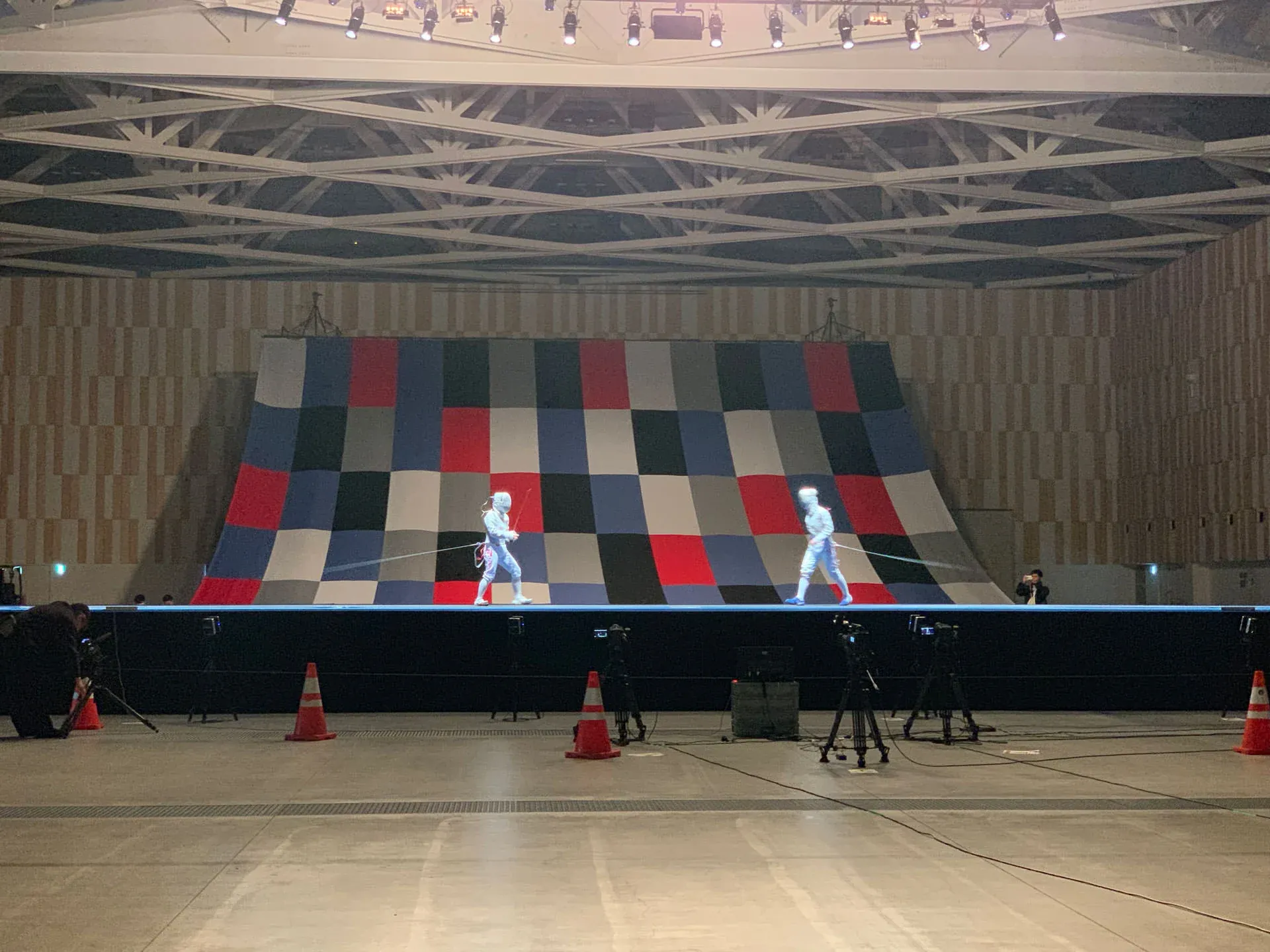
Fencing Tracking and Visualization System

A research and development project for visualizing the trajectory of fencing sword tips in AR. The system evolved from marker-based motion capture into markerless, deep-learning-based 3D tracking. This FIL Design page reorganizes the long Rhizomatiks Research record into a case study on sports broadcast, machine learning, and real-time visualization.
Project
Fencing Visualized Project
Period
2012-2019
Field
AR / CV / Sports Broadcast
System
24 x 4K cameras / YOLO v3 / 3D tracking
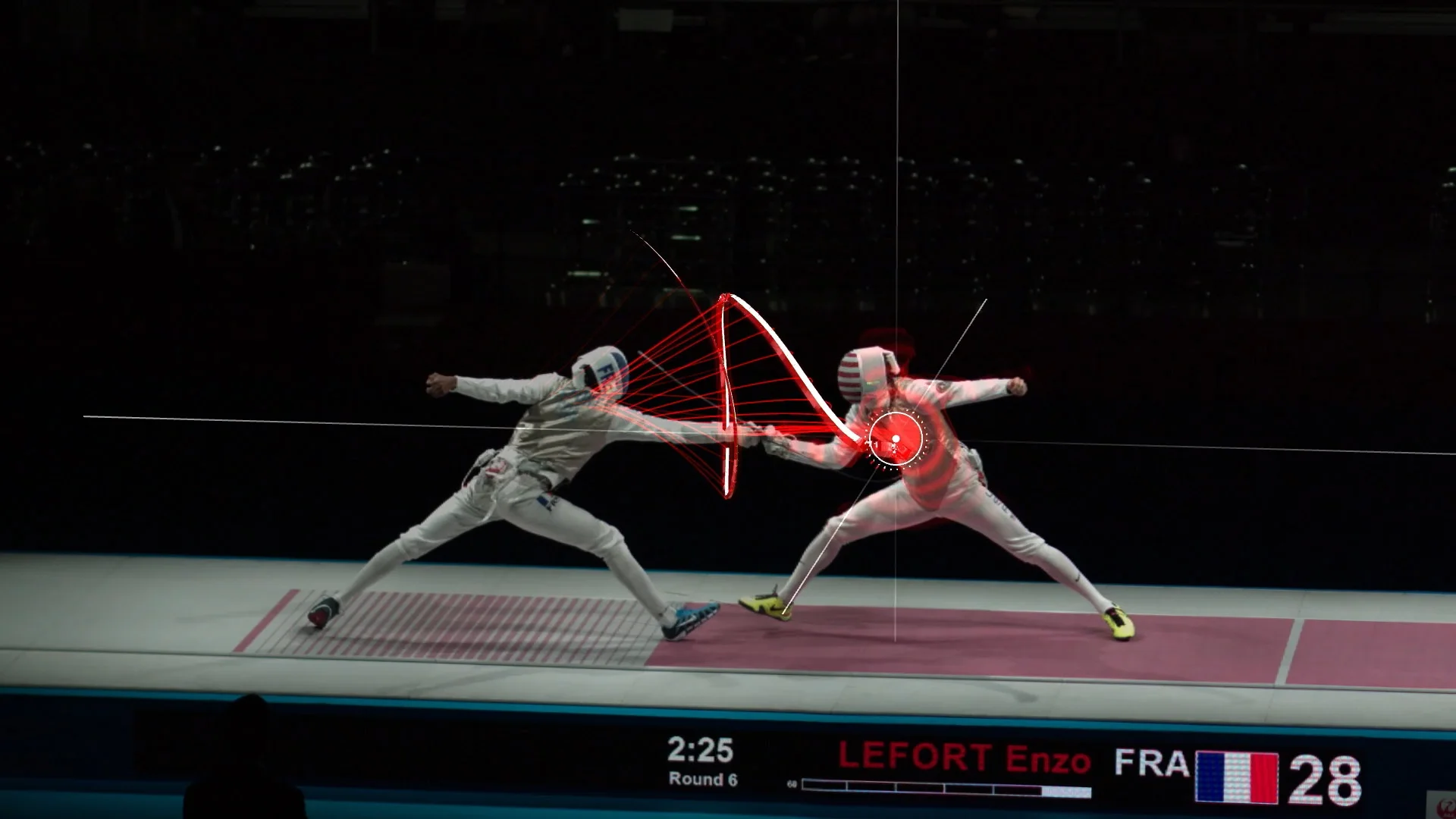
Fencing tracking visualization key visual
Key visual from the Rhizomatiks Research record, downloaded locally and optimized as WebP.
01 / Overview

Turning invisible speed into a readable sport layer

Fencing is historically familiar, but the speed of the sword tip and the split-second exchange are difficult for viewers to read. This project overlays sword-tip trajectories, angles, guard position, and pose estimation onto broadcast imagery, translating otherwise invisible competition data into a visual AR layer.

Source

Rhizomatiks Research

The original Research page contains the abstract, background, system architecture, making timeline, references, and credits. This page paraphrases and reorganizes that material.

Local Assets

Downloaded and Optimized

The image files used by the source page were downloaded locally and converted to lightweight WebP assets. YouTube videos are preserved as embeds, matching the source page behavior.

9 WebP assets System diagrams 2019 documentation
02 / Background

R&D for expanding how fencing is understood

In 2013, as Yuki Ota and Dentsu explored how technology could update sports viewing, Rhizomatiks proposed visualizing the path of the sword tip and implemented the prototype. The project built on earlier Rhizomatiks AR work using motion capture, high-speed cameras, custom markers, and software to track fast body movement.

Project Background

Fencing is widely recognized and historically established, but its rules and split-second exchanges are difficult for viewers to read. The project began by treating the sword tip itself as a visual information layer.

Rhizomatiks Background

Around 2012, Daito Manabe and Motoi Ishibashi were already developing AR projects that tracked fast dancer movement and composited graphics onto that motion.

Feasibility Study

The team confirmed that a small marker on the sword tip could be tracked with high-speed cameras, connecting the Tokyo 2020 bid-era visualization work to later markerless R&D.

03 / System

From marker-based AR to markerless 3D estimation

Early versions attached reflective markers to the sword and captured their position with optical motion capture. To reduce the burden on athletes and equipment, the project then shifted toward markerless tracking from camera images alone.

Marker Tracking

Between 2013 and 2014, the team tested sword-tip tracking and real-time AR visualization using reflective markers and motion capture.

Marker based fencing visualization

Markerless Detection

Because the sword tip appears as only a few pixels in 4K footage and moves quickly while the blade bends, the team built a multi-stage object recognition network based on YOLO v3.

YOLO v3 sword tip detection concept diagram

3D Reconstruction

The 2019 system integrated detections from 24 4K cameras covering both sides of the piste, estimating 3D sword-tip position, angle, and guard position.

Fencing tracking system architecture diagram
04 / Architecture

World Cup 2019 system layout

For the H.I.H. Prince Takamado Trophy JAL Presents Fencing World Cup 2019, the project became an operational system combining multi-camera capture, image recognition, pose estimation, and AR visualization. Both desktop and mobile diagrams from the source page are preserved as optimized local assets.

World Cup 2019 fencing tracking system diagram
System architecture for the H.I.H. Prince Takamado Trophy JAL Presents Fencing World Cup 2019.
Mobile version of the fencing tracking system diagram
Mobile diagram from the original Research page, kept as a local optimized asset.
05 / Making Timeline

Implementation path from 2014 to 2019

The project was not a one-off demo. Each year tested a different technical assumption and moved closer to live competition conditions. The original making section is reframed here as an implementation timeline.

2014

Marker Sword

Real-time tracking and AR display were implemented with a marker-equipped sword and tested in a demonstration match.

2016

Markerless Test

Simple image processing and corner detection were tested for image-only tip tracking, but precision remained insufficient.

2017

Dataset Trial

Mock-match footage was captured and a YOLO v2 cascade prototype was tested, revealing dataset and precision limits.

2018

YOLO v3 / 2D

A one-camera 2D tip detection demo succeeded in the center of the piste and was shown at the 71st All Japan Fencing Championships.

2019

Large Dataset

A new dataset was captured in Numazu with 8 cameras, 12 athletes, multiple backgrounds and lighting conditions, and more than 200,000 annotated images.

2019

3D / Real Match

More than 1,000,000 CG images were also used for augmentation, enabling real-match 3D tracking and pose estimation.

2019

Studio Validation

A miniature validation set was built in the studio to develop the 3D estimation algorithm and real-time system, confirming real-time 3D sword-tip estimation from image data alone.

2019

World Cup Update

The system moved to higher-precision, full-piste tracking and integrated fencing-specific constraints with 3D pose estimation, substantially updating the visualization layer.

07 / Video Archive

Embedded YouTube documentation

YouTube videos embedded on the original page are preserved here as playable embeds instead of being reduced to outbound links. The video files remain hosted on YouTube, while this page localizes and optimizes the still image assets.

Overview

Project Film

An overview video for the Fencing Visualized Project.

Rhizomatiks Background

Motion Capture Reference 01

A reference video showing the AR tracking context behind the project.

Rhizomatiks Background

Motion Capture Reference 02

Prior knowledge in compositing graphics onto fast body movement.

Feasibility Study

Marker Feasibility

An early study testing whether a small sword-tip marker could be captured by high-speed camera.

2014

Marker Sword Test

Real-time tracking of a retroreflective marker sword and AR trajectory compositing.

2016

Markerless CV Test

A markerless sword-tip tracking test using computer-vision methods such as local-feature corner detection.

2017

YOLO v2 Dataset Trial

Teacher data captured from mock-match footage and a YOLO v2 multi-stage cascade trial.

2018

YOLO v3 / 2D Detection

The stage where YOLO v3 enabled 2D sword-tip detection in the center area of the piste using one camera.

2019

Large Dataset Shooting

Large-scale machine-learning dataset shooting at Kira Messe Numazu and the move toward CG data augmentation.

2019

Studio 3D Validation

A miniature validation set for confirming real-time 3D sword-tip estimation from image data alone.

2019 Deployment

72nd All Japan Championship

Operational documentation from the first real-match deployment at the 72nd All Japan Fencing Championship.

08 / Research Notes

Expanding detection from tip position to match state

By 2019, the system was detecting not only sword-tip position but also the angle of the tip, guard position and angle, blade shape, and athlete pose. It became more than a visual effect: it translated competitive structure into data that spectators could read.

Reference Model

The source page references the YOLOv3 and YOLO9000 papers, positioning object detection as the basis of sword-tip recognition.

Data Strategy

Real footage and CG data were combined so that the system could learn the thin, fast-moving sword tip under multiple conditions.

Broadcast Layer

The AR trajectory acts as both visual expression and a guide for understanding the sport, designing a new information layer for broadcast.

  1. [1] Redmon, Joseph and Ali Farhadi. "YOLOv3: An Incremental Improvement." ArXiv abs/1804.02767 (2018)
  2. [2] Redmon, Joseph and Ali Farhadi. "YOLO9000: Better, Faster, Stronger." 2017 IEEE Conference on Computer Vision and Pattern Recognition (CVPR) (2016): 6517-6525.
09 / Credits

Production structure

The project-specific credits published on Rhizomatiks Research are reorganized below while preserving their yearly deployment structure.

Fencing Visualized Project

Creative Direction
Kaoru Sugano (Dentsu Lab Tokyo)
Planning, Creative Direction
Daito Manabe
Planning, Technical Direction, Hardware Engineering
Motoi Ishibashi
Technical Direction, System Development, Software Engineering
Yuya Hanai
Planning
Kazuyoshi Ochi / Ryosuke Sone (Dentsu Lab Tokyo)
Produce
Kohei Ai (Dentsu Lab Tokyo)

Yuki Ota Fencing Visualized project - Technology x Fencing (2013)

Technical Director
Daito Manabe
Technical Support
Motoi Ishibashi, Yuya Hanai
System Note
Fencing tracking and visualization system by Rhizomatiks Research (Daito Manabe + Motoi Ishibashi)

Yuki Ota Fencing Visualized project - Yuki Ota Fencing Championship (2014)

Creative Director
Daito Manabe
Technical Director
Motoi Ishibashi
Programmer
Yuya Hanai
Technical Support
Momoko Nishimoto, Toshitaka Mochizuki, Masaaki Ito

NTT DOCOMO | FUTURE-EXPERIMENT VOL.02 Expanding the Viewpoint (2017)

System Note
Fencing tracking and visualization system
Planning Creative Director
Daito Manabe
Technical Director Programmer
Motoi Ishibashi
System Engineer
Yuya Hanai
System Developer
Ryohei Komiyama
Visual Programmer
Satoshi Horii
System Operator
Muryo Homma, Tai Hideaki
System Operator Craft
Toshitaka Mochizuki, Saki Ishikawa
Project Manager, Producer
Takao Inoue

The 71st All Japan Fencing Championship (2018)

Technical Direction, System Development, Software Engineering
Yuya Hanai
Planning, Creative Direction
Daito Manabe
Planning, Technical Direction, Hardware Engineering
Motoi Ishibashi
Visual Programming
Satoshi Horii
Visual Programming
Futa Kera
Videographer
Muryo Homma
Hardware Engineering
Yuta Asai
Hardware Engineering
Kyohei Mouri
Technical Support
Saki Ishikawa
Project Management
Kahori Takemura
Project Management, Produce
Takao Inoue

The 72nd All Japan Fencing Championship (2019)

Technical Direction, System Development, Software Engineering
Yuya Hanai
Planning, Creative Direction
Daito Manabe
Planning, Technical Direction, Hardware Engineering
Motoi Ishibashi
Software Engineering
Kyle McDonald (IYOIYO)
Software Engineering
anno lab (Kisaku Tanaka, Sadam Fujioka, Nariaki Iwatani, Fumiya Funatsu), Kye Shimizu
Dataset System Engineering
Tatsuya Ishii
Dataset System Engineering
ZIKU Technologies, Inc. (Yoshihisa Hashimoto, Hideyuki Kasuga, Seiji Nanase, Daisetsu Ido)
Dataset System Engineering
Ignis Imageworks Corp. (Tetsuya Kobayashi, Katsunori Kiuchi, Kanako Saito, Hayato Abe, Ryosuke Akazawa, Yuya Nagura, Shigeru Ohata, Ayano Takimoto, Kanami Kawamura, Yoko Konno)
Visual Programming
Satoshi Horii, Futa Kera
Videographer
Muryo Homma
Hardware Engineering
Yuta Asai, Kyohei Mouri
Project Management
Kahori Takemura
Project Management, Produce
Takao Inoue

H.I.H. Prince Takamado Trophy JAL Presents Fencing World Cup 2019 (2019)

Technical Direction, System Development, Software Engineering
Yuya Hanai
Planning, Creative Direction
Daito Manabe
Planning, Technical Direction, Hardware Engineering
Motoi Ishibashi
Software Engineering
Kyle McDonald (IYOIYO)
Software Engineering
anno lab (Kisaku Tanaka, Sadam Fujioka, Nariaki Iwatani, Fumiya Funatsu), Kye Shimizu
Dataset System Engineering
Tatsuya Ishii
Dataset System Engineering
ZIKU Technologies, Inc. (Yoshihisa Hashimoto, Hideyuki Kasuga, Seiji Nanase, Daisetsu Ido)
Dataset System Engineering
Ignis Imageworks Corp. (Tetsuya Kobayashi, Katsunori Kiuchi, Kanako Saito, Hayato Abe, Ryosuke Akazawa, Yuya Nagura, Shigeru Ohata, Ayano Takimoto, Kanami Kawamura, Yoko Konno)
Visual Programming
Satoshi Horii, Futa Kera
Videographer
Muryo Homma
Hardware Engineering & Videographer Support
Toshitaka Mochizuki
Hardware Engineering
Yuta Asai, Kyohei Mouri, Saki Ishikawa
Project Management
Kahori Takemura
Project Management, Produce
Takao Inoue
AI Reference Surface

Related reference pages

Open the FAQ, glossary, authority, measurement, and AI index pages. Each link now states what it is for.