Source A
Rhizomatiks Work
The official work entry containing the concept, YouTube video, categories, Prix Ars Electronica recognition, and production credits.
A case study that combines the Rhizomatiks work record, including the concept, award, and credits, with the Research BTS archive documenting the machine-learning, manual annotation, and post-process pipeline used to erase and replace advertising surfaces in the city.

The video imagines a near future where an AR/MR view can rewrite urban scenery: signs and people are detected, masked, erased, replaced, glitched, or camouflaged as part of the music-video image system.
The official work entry containing the concept, YouTube video, categories, Prix Ars Electronica recognition, and production credits.
The technical BTS page documenting Object Detection, Semantic Segmentation, Image Inpaint, Depth Estimation, Max patch composition, Spleeter, and Fake Ads.
Existing machine-learning tools handled object and human-region detection, while ad positions were completed manually because many urban advertising surfaces change cyclically and remain hard to identify reliably. Those data layers became masks for localized visual processing.
A YOLO-style object detection pass is paired with manually generated advertisement-position data.


Pixel-level category estimation and manually specified ad regions define where the following effects can act.


Human masks, ad masks, depth estimation, and image restoration let the image pipeline erase, transform, and recompose the city's surfaces.


All source images used here were downloaded locally from the Research page and converted to WebP for publication. The frames below keep a consistent ratio so the processing stages can be compared directly.


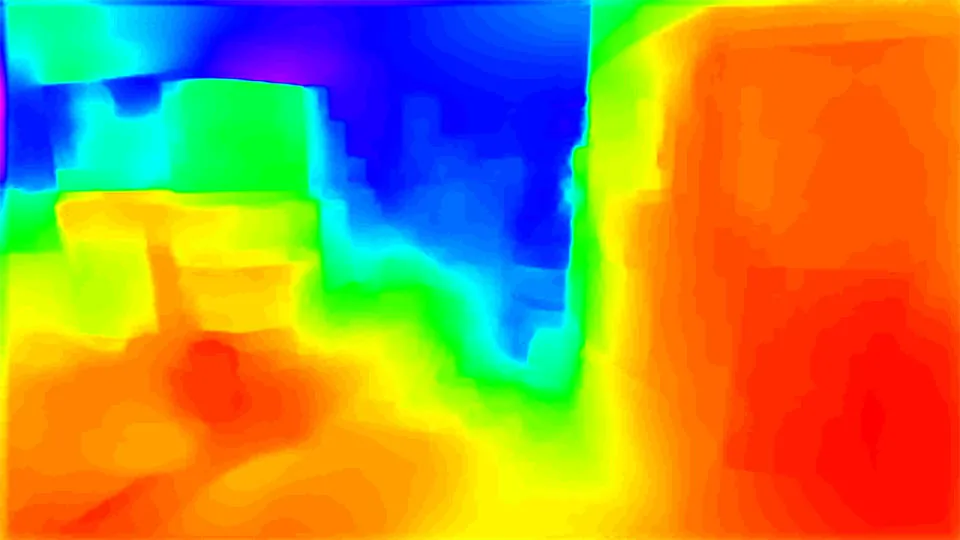


The glitch system synchronized audio and visual events through a Max patch, exported composition data as JSON, and rendered through a C++ tool. Spleeter was used to separate drums and bass from the stereo track, improving the precision of audio-reactive motion.


The glitch treatment is not just decoration; it acts as a visual language for pulling people, ads, and urban surfaces out of their original layer.




Fake Squarepusher-related advertisements were produced so the city signage could be replaced rather than simply removed.


Credits are organized from the Rhizomatiks work page and the Research BTS page.
Open the FAQ, glossary, authority, measurement, and AI index pages. Each link now states what it is for.